How Trainable is Your VO2 Max?
Key Points
What is VO2 Max?: VO2 max is a crucial measure of cardiovascular fitness, reflecting the maximum amount of oxygen your body can utilize during exercise.
Importance of VO2 Max: This metric is valuable for both athletes and the general population, as it relates to endurance, overall fitness, and long-term health.
Improving VO2 Max: Through targeted endurance training, VO2 max can be significantly improved, although progress varies depending on individual factors.
Understanding Limits: There are natural limits to how much VO2 max can increase, influenced by genetics, training type, and sport-specific demands.
Maintaining VO2 Max: Sustaining a high VO2 max requires ongoing effort, particularly as it tends to decline with age, making regular, focused training essential.
Recently, I got my VO2 max tested. As someone who rarely does any compound movements for more than five reps, I’ve got to say that it wasn’t particularly fun. But a friend and client of mine, Dr. Mary Pardee, who owns Modrn Med, a functional medicine practice located in Los Angeles, bought a new VO2 max testing kit. I volunteered to be her guinea pig as she learned to work it, because I, like her, love fitness gadgets.
I was in the 76th percentile for my demographic, just short of "Excellent" and instead had to settle for "Good." This will come as no surprise to anyone who knows me, but I can be pretty competitive, and I don’t like not being excellent at anything I do, especially in the fitness space. So I’ve decided to dedicate a chunk of my training to getting my VO2 max up. The whole experience has made me think about the question: “How much better can I get my VO2 max?” And then I thought this would be a good idea for a blog post, so here we are.
Now, let's dive deeper into what VO2 max actually represents and why it's so important. VO2 max is the maximum rate (V) of oxygen (O2) your body can use during exercise. It’s important because it is a critical measure of cardiovascular fitness and aerobic endurance. In sports, it is often used to predict an athlete's performance potential in endurance sports like running, cycling, and swimming since athletes with higher VO2 max values tend to perform better in activities that require sustained aerobic effort. Furthermore, monitoring changes in VO2 max over time can help athletes and fitness enthusiasts track the effectiveness of their training programs. Improvements in VO2 max usually signify improvements in aerobic fitness, while decreases may indicate overtraining or health issues. For this reason, as Verro grows, or if there is enough demand for it, we may end up getting a VO2 tester in the gym. But they aren’t cheap, so let’s see how well this blog goes first. While VO2 max is important for athletes, it is also a useful metric for the general population. Low VO2 max values have been associated with an increased risk of cardiovascular disease, obesity, and premature mortality, so it’s worth your time to try and develop it.
To answer the question of how much you can increase your VO2 max, it’s important to provide the right context. What is your starting point? What is your level of training? What type of training do you do? How long have you been doing it? How frequently and intensely do you train? What are your age, sex, and weight? All of these factors play a role in how much more oxygen you’ll be able to utilize during exercise. The scope of this blog post is to provide the context and scientific information necessary to answer this question.
UNDERSTANDING VO2 MAX
As mentioned previously, VO2 max is the maximum rate of oxygen your body can use during exercise. Getting a VO2 max test is essentially a way to measure how efficiently your body uses oxygen during exercise. Before starting a VO2 max test, you'll likely go through a quick health screening to ensure you're safe to participate. Once you're set up with the necessary equipment, such as a mask or mouthpiece connected to a machine, you'll start with a warm-up to get your body ready. Then, you'll hop on a treadmill or stationary bike and begin exercising at a low intensity. From there, the intensity gradually increases in stages, with each stage lasting a few minutes. Throughout the test, you'll breathe into the mask or mouthpiece, which is connected to equipment that analyzes the composition of the air you're breathing in and out. This allows the testers to measure how much oxygen you're consuming and how much carbon dioxide you're producing.
As the test progresses, the workload will continue to increase until you reach a point where you can no longer maintain the required intensity. This typically happens when you feel too fatigued to continue or when your oxygen consumption reaches a plateau despite increasing effort. After the test, there's a cool-down period to help your body gradually return to its resting state. The data collected during the test, including your oxygen consumption and heart rate responses, are then analyzed to determine your VO2 max, which is a measure of your aerobic fitness level.
In a VO2 max test, the measurement of oxygen consumption (VO2) in milliliters per kilogram of body weight per minute (ml/kg/min) is a crucial indicator of aerobic fitness. This unit reflects the amount of oxygen your body can use per kilogram of body weight per minute during maximal exertion. By normalizing oxygen consumption to body weight, ml/kg/min allows for a more accurate comparison of individuals with varying weights, ensuring a fair assessment of aerobic capacity. During the test, as exercise intensity increases, so does oxygen consumption, reflecting the body's increasing demand for oxygen to fuel muscular activity. Good VO2 max values vary depending on factors such as age, gender, and fitness level, but generally, higher values indicate better aerobic fitness.
For some context, the baseline normative values of VO2 max in healthy young adults (17-28 years) were established at 34.09 ± 4.34 ml/kg/min when on a treadmill according to a 2023 study by Kothari (1). For older populations, aged 72.6 ± 4.8 for men and 71.0 ± 5.1 for women, VO2 max was measured at 21.7 ± 4.8 ml/kg/min and 17.3 ± 4.0 ml/kg/min for men and women respectively, according to an observational study by Peterson in 2003 (2). For sedentary individuals, VO2 max values may range from 20-40 ml/kg/min, while elite athletes can achieve values exceeding 60 ml/kg/min. However, what constitutes a "good" VO2 max depends on individual goals and the specific demands of their chosen sport or activity.
For reference, you can look up where you stack up compared to your age and sex in the table below (FIGURE 1), which comes from a 2018 study by Mandsager et al. (3).
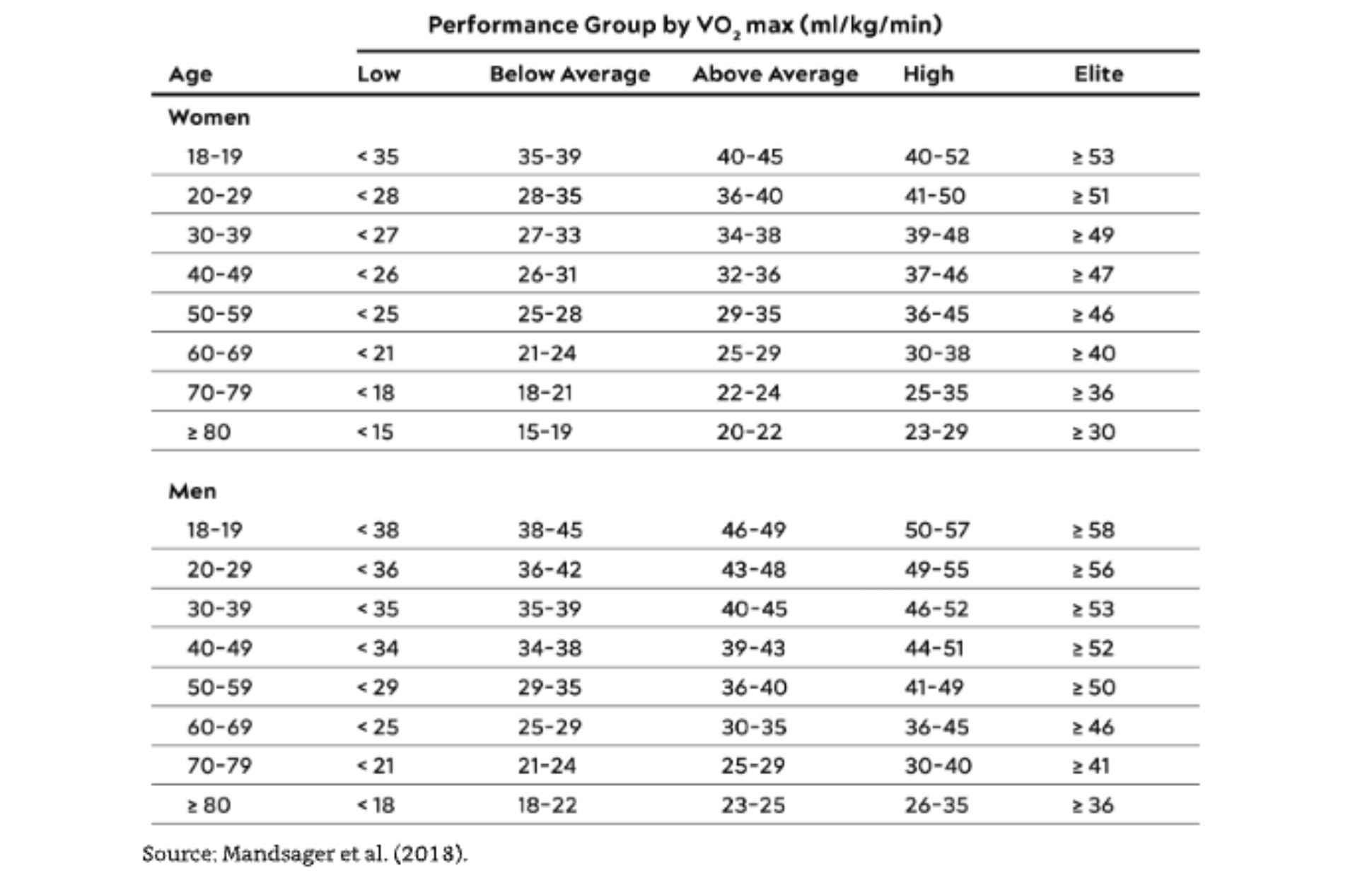
FIGURE 1
VO2 Max by Age, Sex, Fitness
My first time getting my VO2 max tested, I got 47.5 ml/kg/min, which was good but not excellent. My goal is to get to 60 ml/kg/min because I want to be considered elite. But how realistic is that? And how long will it take? Since I don’t do a whole lot of intense cardio training, I’m betting it’ll improve some, but is a 12.5 ml/kg/min increase realistic? Let’s investigate what science has to say.
With a clear understanding of what VO2 max is, let's explore how adaptable this metric is through training.
ADAPTABILITY OF VO2 MAX
It should come as no surprise that endurance training is the best way to increase your VO2 max, but it might be a bit of a grind and take you awhile. A 1995 study from Phillips et al. found that endurance training led to improvements of 2% in VO2 max for 7 untrained men aged 23 +/-1 over the span of 30 days of training (4). This is a good start, but if I’m going to hit 60 ml/kg/min, 2% isn’t going to cut it. That would only get me to about 48.5 mL/kg/min.
But time is on my side. While the time course of VO2 max improvement can vary, over time you can see pretty substantial change. One study from Smith et al. reported a 13.6% increase in VO2 max in healthy male subjects after 36 weeks of training (5). An interesting note about this is that according to the researchers, improvements in VO2 max were not solely due to increased oxygen delivery but also to enhanced peripheral utilization of oxygen, as indicated by significant increases in the anaerobic threshold (5). For me this would be good, but not great. A 13.6% increase from my original measurement would only be 54 ml/kg/min…close but no cigar. Looks like I’m going to be spending even more time on the treadmill.
As you train, it's important to understand the natural limits of VO2 max and how far it can be pushed.
Luckily, there is some evidence that progress can continue for quite some time. A 2018 case report from Laury et al. found some remarkable gains in non-elite recreational athletes, with as much as 96% improvement in VO2 max over 24 months of selective intense training (6). I should note that their starting levels were significantly less than mine, and I’m not sure if baseline tests were a true VO2 max. I am not naive enough to think that I’ll be able to improve my VO2 max by 96%. That would be 93.1 mL/kg/mil. For context of how unlikely this is, the widely accepted highest VO2 max ever recorded was by Norwegian cross-country skier Bjørn Dæhlie. His VO2 max was reported to be 96 ml/kg/min. But I do think the point illustrates that if 60 is really my goal, I can get pretty close given enough time and training.
LIMITS OF VO2 MAX
Progress can’t continue indefinitely. This is true for most things, VO2 max included. Eventually a plateau will occur. We’ve already mentioned one limit, of 96 mL/kg/min, which is likely the upper limit for VO2 max in humans. Eventually VO2 max is limited primarily by cardiac output and locomotor muscle blood flow in a normoxic environment, which is according to findings from Saltin et al. (7).
Different types of athletes seem to have different limits for VO2 max. Endurance athletes like cyclists, runners, or cross-country skiers, elite-level VO2 max values typically range from around 60 to 85 ml/kg/min for males and 50 to 75 ml/kg/min for females. Team sports athletes like soccer players, basketball players, and field hockey players require a mix of aerobic and anaerobic fitness. As such, elite-level players still typically exhibit VO2 max values above average for the general population, but below endurance athletes, often ranging from 55 to 65 ml/kg/min for males and 45 to 55 ml/kg/min for females. Athletes like myself who focus on strength and power above other adaptations (powerlifters, weightlifters, sprinters), typically have lower levels of VO2 max levels since we primarily focus on a different source of energy than oxygen to exercise. Average VO2 max levels are usually around 45-55 mL/kg/min for men and 35-45 mL/kg/min for women. Coincidentally, this is about the range I find myself in.
What I think this illustrates is there are certain levels of VO2 max that are good enough for the sport you are competing in. That said, overshooting is likely not a bad idea, as there really isn’t too much of a downside in having too high a VO2 max, so long as training doesn’t interfere with other training work. It's also worth noting that VO2 max values can vary depending on factors such as genetics, training history, and testing methodology.
After working hard to improve your VO2 max, maintaining it is key. Here's what you need to know about VO2 max over the long term.
To avoid overtraining while maximizing the benefits of VO2 max training, athletes should consider interval training with durations and intensities that allow for extended maintenance of VO2 max without excessive fatigue. Whatever training you are doing to improve your max, I’d look for metrics of improvement, and if performance ever starts to dip, it may be a sign that you are training too hard or some training variable needs to change.
MAINTAINING VO2 MAX
Like most things, VO2 max usually declines with age. Research from Brotz et al. suggests that VO2 max declines an average of 0.33 mL/kg/min or 0.5% per year after age 35 (8). However, the rate of decline can be influenced by factors such as physical activity level, gender, and muscle mass loss.
Interestingly, the absolute rate of decline in VO2 max is greater in physically active women compared to sedentary peers, with a decline of -5.7 ml/kg/min/decade for active women versus -3.2 ml/kg/min/decade for sedentary women, although the relative percentage rate of decline is similar between the two groups (9). In men, the absolute rates of decline in VO2 max with age are not significantly different across sedentary, active, and endurance-trained groups, with rates around -4.0 to -4.6 ml/kg/min/decade, and the relative rates of decline are also similar, ranging from -6.8% to -8.7% per decade (10).
If you are aged between 25 and 80 years old, you should probably be concerned with your VO2 max declining, as illustrated in FIGURE 2. The study involving 48 subjects from 2000 by Conley et al. found that there is a steady decline in VO2 max as we age (11).
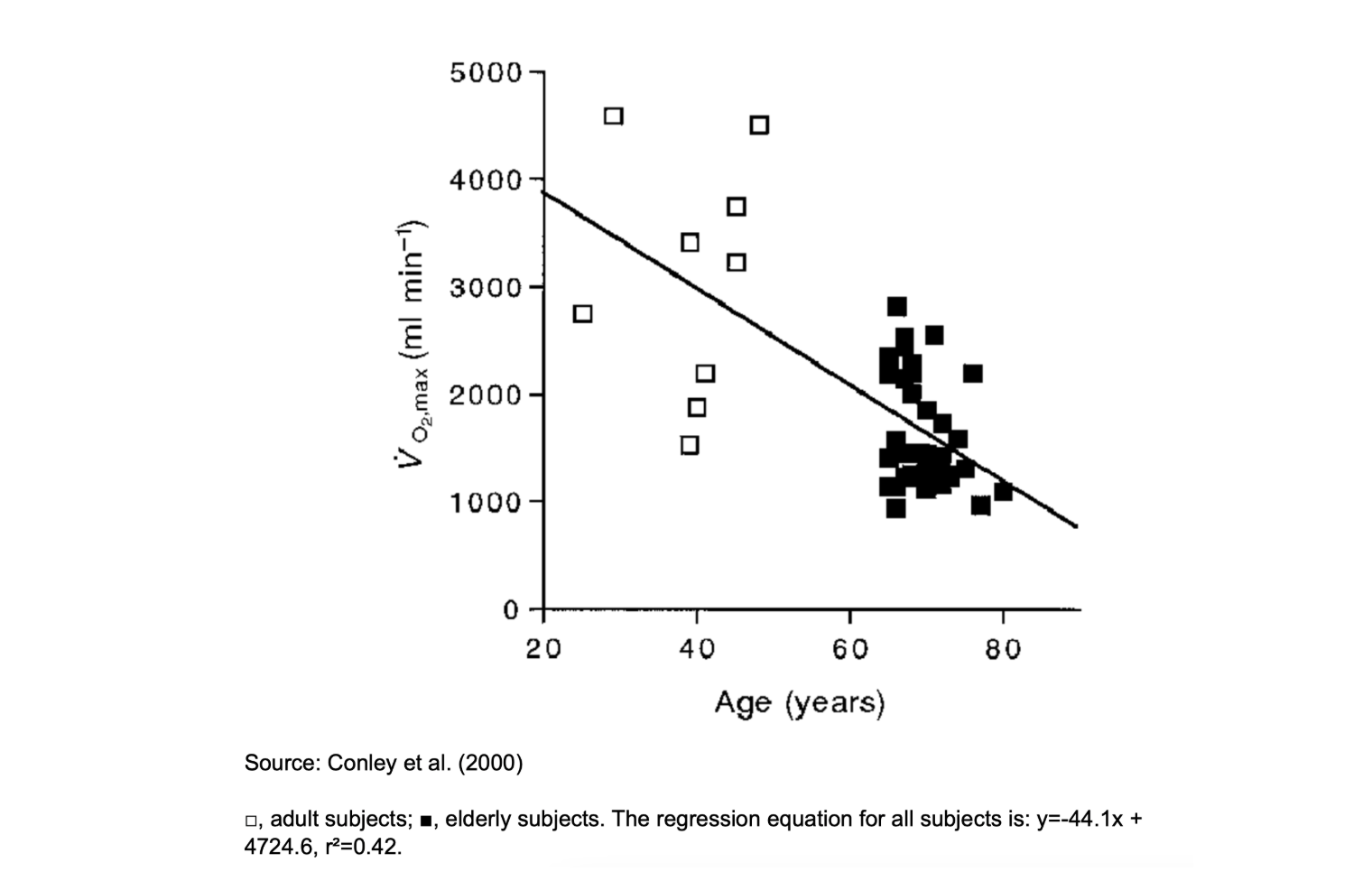
FIGURE 2
Maximal Oxygen Uptake Rate (VO2 Max) As a Function of Age
This again illustrates how important actively maintaining your VO2 max is as you age. But let’s say that you have gotten your VO2 max up, how difficult is it to keep it? Like all things, it depends. Elite athletes will have a tougher time staying at that level than someone who just does cardio at a more casual level. Practically, when training you should aim for 2-3 days of relatively intense aerobic training. The data gives us some good direction as far as what to do and how much to do.
Interval training seems to be a good idea, once study from Billat found that short interval training (15s hard, 15s easier) at velocities around critical velocity was effective in maintaining VO2 max in middle-aged runners, with specific amplitude ratios (90-80% and 100-70% of VO2 max) being most efficient (12). High-intensity training also seems to be effective. High-intensity treadmill interval training at the running speed associated with VO2 max for durations of 60% of the time for which this speed can be maintained (Tmax) improves 3000-m running performance and may influence VO2 max according to a study from (10).
Practically, a good vo2 max training program might look something like this: Let's say an individual's Tmax at their VO2 max running speed is 10 minutes. They would perform intervals lasting 6 minutes each. Here's how the workout might look:
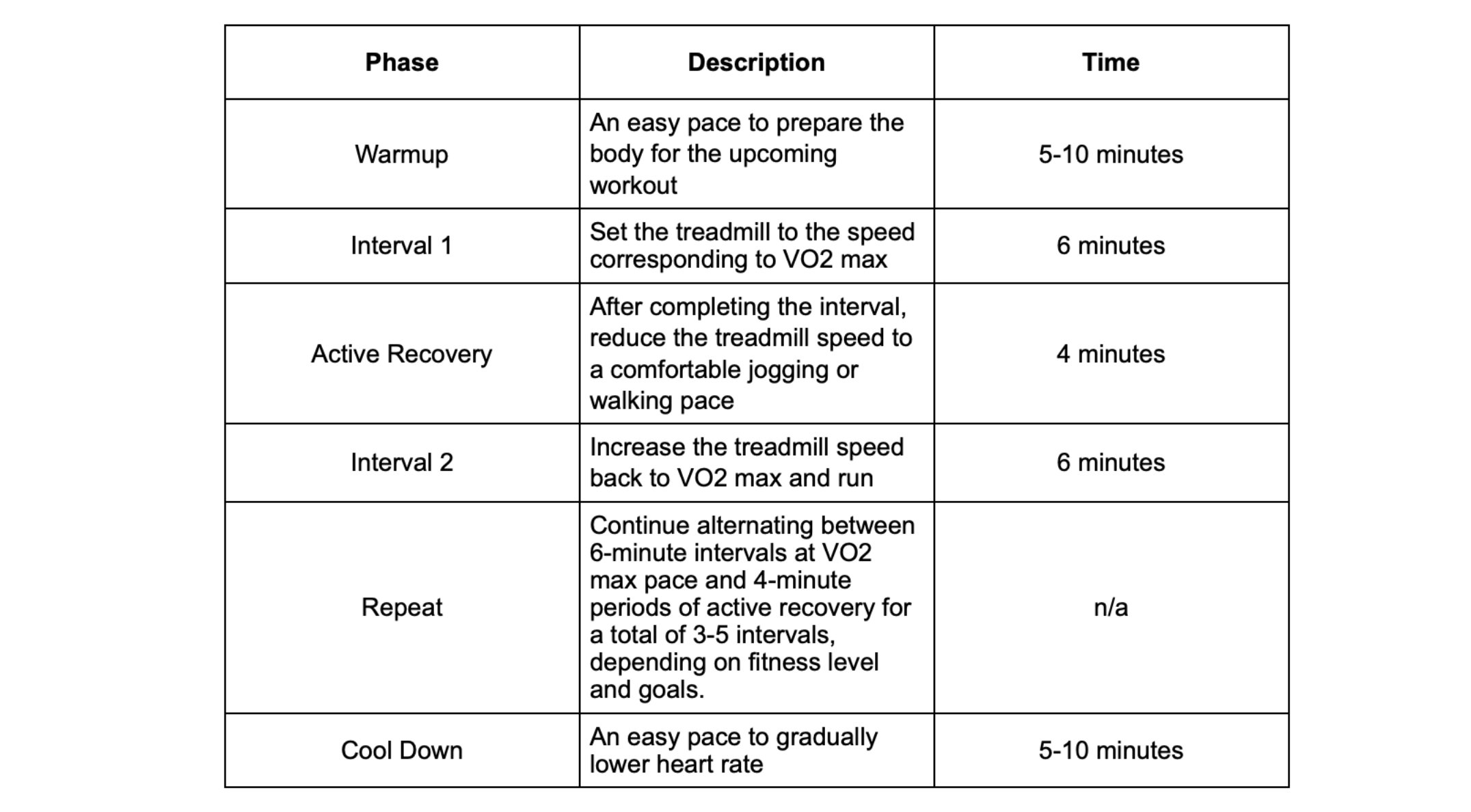
FIGURE 3
Recommendation for VO2 Max Training
I should also note that endurance training over 36 weeks has been shown to significantly increase VO2 max and anaerobic threshold (AT), with disproportionate increases in AT occurring earlier in the training program (13).
Let me share my personal plan to improve my VO2 max while balancing my other fitness goals. This training method challenges the body's aerobic capacity while providing sufficient recovery periods to maintain intensity throughout the workout. Over time, consistent implementation of this interval training approach can lead to improvements in both running performance and aerobic fitness.
MY PLAN
I still want to keep getting big and strong, which is my main focus. But one benefit of working in a gym is that it is pretty easy for me to add a bit more to my training program. The current plan is for the next 6 weeks to train my VO2 max 4 days a week. The program would look something like this.
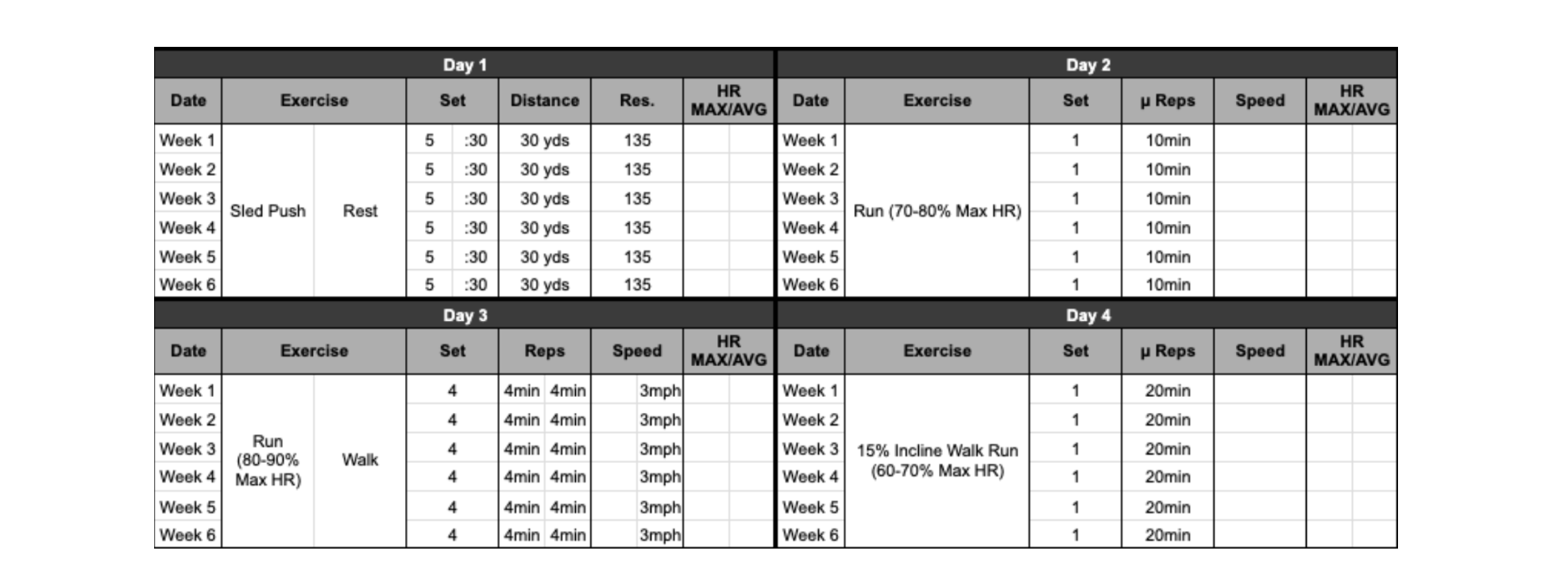
FIGURE 4
Frank’s VO2 Max Training Protocol
This journey is not just about hitting a number; it's about pushing my limits and seeing how far I can go. Even if I don't hit 60 ml/kg/min, the process of striving for it will undoubtedly make me a better, more well-rounded athlete.
I’ll fill in all the black slots as information comes in, but the basic idea is that I am training my heart at different levels throughout the week and seeing where I can make the most adaptation, and then lean into that for future training. Nothing is too difficult because I still want to work on some other things in training.
CONCLUSION
My best guess on what is achievable for my status right now is about a 20% increase in VO2 max, which would get me up to 57 ml/kg/min. Close to that elusive 60…but not quite. However time will tell how right or wrong I am. The journey toward improving VO2 max encapsulates both scientific inquiry and individual endeavor. While the initial impetus often revolves around athletic performance, the significance of cardiovascular fitness extends well beyond the realm of sports, encompassing broader health and longevity considerations.
From a scientific perspective, we've delved into the intricacies of VO2 max testing, examined the variables influencing its adaptability, and explored the boundaries of its enhancement. Through rigorous analysis of research findings and practical insights into training methodologies, we've gained a deeper understanding of this pivotal physiological metric.
Sources:
Kothari, R., Srivastava, S., Vrindavanam, S., Sharma, S., & Bokariya, P. (2023). Normative study of VO2 max in healthy young adults upon exercise on treadmill and cycle ergometer. International Journal of Research in Medical Sciences. https://doi.org/10.18203/2320-6012.ijrms20230589.
Peterson, M., Pieper, C., & Morey, M. (2003). Accuracy of VO2(max) prediction equations in older adults.. Medicine and science in sports and exercise, 35 1, 145-9 . https://doi.org/10.1097/00005768-200301000-00022.
Mandsager K, Harb S, Cremer P, Phelan D, Nissen SE, Jaber W. Association of Cardiorespiratory Fitness With Long-term Mortality Among Adults Undergoing Exercise Treadmill Testing. JAMA Netw Open. 2018;1(6):e183605. Published 2018 Oct 5. doi:10.1001/jamanetworkopen.2018.3605
Phillips, S., Green, H., MacDonald, M., & Hughson, R. (1995). Progressive effect of endurance training on VO2 kinetics at the onset of submaximal exercise.. Journal of applied physiology, 79 6, 1914-20 . https://doi.org/10.1152/JAPPL.1995.79.6.1914.
Smith, D., & O'DONNELL, T. (1984). The time course during 36 weeks' endurance training of changes in Vo2 max. and anaerobic threshold as determined with a new computerized method.. Clinical science, 67 2, 229-36 . https://doi.org/10.1042/CS0670229.
Laury, D., & Tehrany, A. (2019). VO 2 Max Improvement of 96% in a Non-Elite Recreational Athlete over 24 Months. The Surgery Journal, 5, e25 - e27. https://doi.org/10.1055/s-0039-1688438.
Saltin, B., & Calbet, J. (2006). Point: in health and in a normoxic environment, VO2 max is limited primarily by cardiac output and locomotor muscle blood flow.. Journal of applied physiology, 100 2, 744-5 . https://doi.org/10.1152/japplphysiol.01395.2005.
Billat, V., Slawinksi, J., Bocquet, V., Chassaing, P., Demarle, A., & Koralsztein, J. (2001). Very short (15s-15s) interval-training around the critical velocity allows middle-aged runners to maintain VO2 max for 14 minutes.. International journal of sports medicine, 22 3, 201-8 . https://doi.org/10.1055/S-2001-16389.
Tanaka, H., Desouza, C., Jones, P., Stevenson, E., Davy, K., Seals, D., & Seals, D. (1997). Greater rate of decline in maximal aerobic capacity with age in physically active
Smith, T., Coombes, J., & Geraghty, D. (2003). Optimising high-intensity treadmill training using the running speed at maximal O2 uptake and the time for which this can be maintained. European Journal of Applied Physiology, 89, 337-343. https://doi.org/10.1007/s00421-003-0806-6.
Conley, K., Esselman, P., Jubrias, S., Cress, M., Inglin, B., Mogadam, C., & Schoene, R. (2000). Ageing, muscle properties and maximal O2 uptake rate in humans. The Journal of Physiology, 526. https://doi.org/10.1111/j.1469-7793.2000.00211.x.
Billat, V., Slawinksi, J., Bocquet, V., Chassaing, P., Demarle, A., & Koralsztein, J. (2001). Very short (15s-15s) interval-training around the critical velocity allows middle-aged runners to maintain VO2 max for 14 minutes.. International journal of sports medicine, 22 3, 201-8 . https://doi.org/10.1055/S-2001-16389.
Smith, D., & O'DONNELL, T. (1984). The time course during 36 weeks' endurance training of changes in Vo2 max. and anaerobic threshold as determined with a new computerized method.. Clinical science, 67 2, 229-36 . https://doi.org/10.1042/CS0670229.
Wilson, T., & Tanaka, H. (2000). Meta-analysis of the age-associated decline in maximal aerobic capacity in men: relation to training status.. American journal of physiology. Heart and circulatory physiology, 278 3, H829-34 . https://doi.org/10.1152/AJPHEART.2000.278.3.H829.
DISCLAIMER
The information in this article is for educational and informational purposes only and is not intended as medical advice, diagnosis, or treatment. Always consult with a qualified healthcare provider or medical professional before beginning any new exercise, rehabilitation, or health program, especially if you have existing injuries or medical conditions. The assessments and training strategies discussed are general in nature and may not be appropriate for every individual. At Verro, we strive to provide personalized guidance based on each client’s unique needs and circumstances.