Minimalist Workouts to Build Strength Without Adding Too Much Muscle Mass (2 SAMPLE PROGRAMS)
Key Points
Strength training improves health and longevity without requiring excessive muscle growth when training variables are tailored appropriately.
Using controlled tempos and focusing on compound movements builds functional strength and mobility while minimizing hypertrophy.
Full range of motion in every exercise ensures both strength and mobility gains, enhancing joint health and movement quality.
Introduction:
This post is a companion piece to my previous discussion on how women can get stronger without adding too much muscle mass. While that post explained the principles behind building strength and mobility while minimizing hypertrophy, this one focuses on practical implementation.
Here, I’m sharing two sample programs: a one-day-a-week plan for those who need simplicity and efficiency and a two-day-a-week plan for those who can dedicate more time. Both programs incorporate all six fundamental movement patterns—squat, hinge, vertical press, vertical pull, horizontal press, and horizontal pull—while adhering to controlled tempos and tailored progression. If you’re looking for a clear roadmap to build strength without compromising your aesthetic goals, these programs offer a solid starting point.
Program Design
The programs outlined below are carefully designed to align with the principles of building strength while minimizing muscle growth. Both the one-day and two-day programs are built around compound movements and the 3-2-1 tempo (3 second eccentric - 2 seconds isometric - 1 second concentric) to develop functional strength and mobility while avoiding excessive hypertrophy. Compound exercises like squats, deadlifts, and presses engage multiple muscle groups simultaneously, improving overall strength and efficiency (1). The controlled tempo enhances neuromuscular control, joint stability, and strength adaptations (2).
The key difference between the one-day and two-day programs lies in training volume, exercise variation, and focus areas. The one-day program is ideal for those with limited time. It includes all six fundamental movement patterns—squat, hinge, vertical press, vertical pull, horizontal press, and horizontal pull—ensuring a full-body workout that targets all major muscle groups. This approach provides the essential foundation for building strength and mobility while maintaining simplicity and efficiency.
The two-day program, however, allows for more variation and additional emphasis on areas that may be underutilized in larger compound movements. For example, exercises like dumbbell Bulgarian split squats and hip thrusts offer more focused training for the glutes and stabilizing muscles, which can complement the larger compound lifts. Similarly, Pallof presses and planks provide core stability work that enhances overall movement quality. This program is better suited for those who have the time to train more frequently and want to address specific weaknesses or imbalances.
Both programs emphasize low rep ranges (3–6), moderate intensity (RPE 6–8), and full ranges of motion to ensure balanced strength and mobility adaptations. Whether you choose one or two days, both approaches offer a structured, evidence-based plan for building strength while aligning with individual aesthetic and functional goals.
Program 1: One-Day-A-Week Strength Program
This minimalist program is designed for efficiency, targeting all six fundamental movement patterns in a single session largely using supersets and a 3-2-1 tempo.
Superset 1
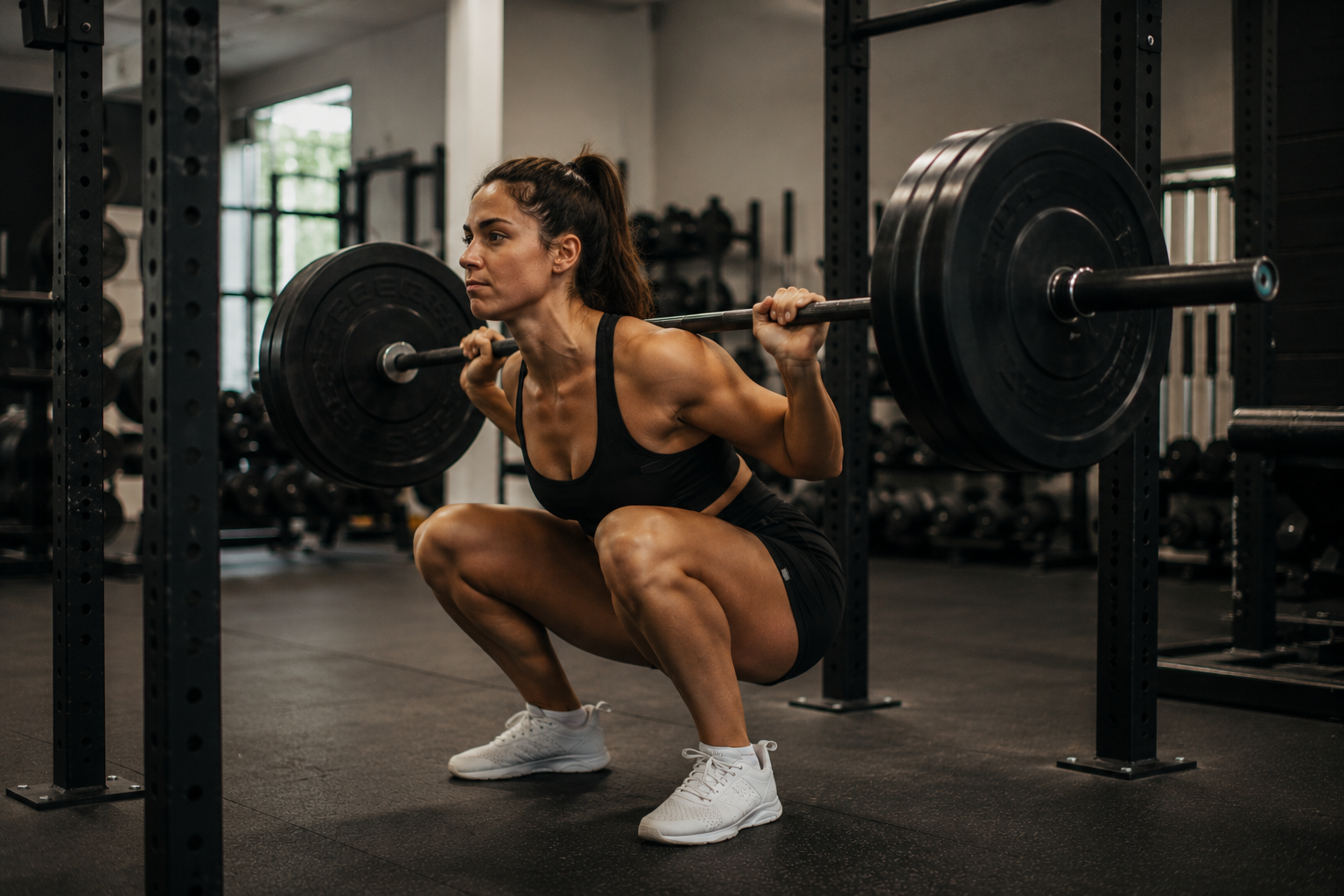
3-2-1 Barbell Back Squats (Squat): 3 sets of 3–5 reps @ RPE 6–8
3-2-1 Single-Arm Dumbbell Rows (Horizontal Pull): 3 sets of 4–6 reps @ RPE 6–8
Superset 2
3-2-1 Barbell Hover Deadlifts (Hinge): 3 sets of 3–5 reps @ RPE 6–8
3-2-1 Dumbbell Bench Press (Horizontal Press): 3 sets of 4–6 reps @ RPE 6–8
Superset 3
3-2-1 Lat Pulldowns (Vertical Pull): 3 sets of 3–5 reps @ RPE 6–8
Seated Dumbbell Overhead Press (Vertical Press): 3 sets of 4–6 reps @ RPE 6–8
Program 2: Two-Day-A-Week Strength Program
This program spreads the training over two days, allowing for slightly more volume and variety. It also largely adheres to the 3-2-1 tempo and targets all six fundamental movement patterns.
Day 1
3-2-1 Barbell Back Squats (Squat): 4 sets of 3–5 reps @ RPE 6–8
3-2-1 Low Rows (Horizontal Pull): 4 sets of 4–6 reps @ RPE 6–8
Seated Dumbbell Overhead Press (Vertical Press): 3 sets of 4–6 reps @ RPE 6–8
Superset:
3-2-1 Dumbbell Hip Thrusts (Hinge): 2 sets of 4–6 reps @ RPE 6–8
Plank: 2 sets done to failure
Day 2
3-2-1 Barbell Hover Deadlifts (Hinge): 3 sets of 3–5 reps @ RPE 6–8
3-2-1 Barbell Bench Press (Horizontal Press): 3 sets of 4–6 reps @ RPE 6–8
3-2-1 Lat Pulldowns (Vertical Pull): 4 sets of 3–5 reps @ RPE 6–8
Superset:
3-2-1 Dumbbell Bulgarian Split Squats: 2 sets of 4–6 reps @ RPE 6–8
Pallof Press: 2 sets of 4–6 reps @ RPE 6–8
Progression Model
In order to get stronger, you’ll have to progressively overload your lifts over time. Both programs follow a triple progression model, where you progress through reps and RPE before increasing weight. Start by performing all sets at the lower end of the rep range within the target RPE. Once you can complete all sets at the top end of the rep range without exceeding the RPE, progress by slightly increasing the RPE the following week. When you consistently hit the highest reps and RPE range, increase the weight and repeat the process.
This approach ensures steady strength gains while avoiding overtraining or excessive hypertrophy. If you struggle to complete the minimum reps within the RPE range, reduce the weight. If the RPE feels too low, increase the weight to maintain progression.
Additional Notes
These sample programs are a practical guide to building strength and mobility without adding excessive muscle mass. However, training programs often need adjustments to fit your unique goals, strengths, and weaknesses. For instance, you may need to modify exercise selection, rep ranges, or tempo based on your current abilities and priorities.
If you’re unsure how to tailor the program to your needs or want a more curated plan, consulting a qualified personal trainer can provide the guidance you need to optimize your results. Personalized coaching ensures your training aligns with your goals, allowing you to build strength and confidence efficiently.
Conclusion
Strength training is a powerful tool for improving health, mobility, and longevity. These programs provide a structured way to train all six fundamental movement patterns while emphasizing full ranges of motion and controlled tempos. By following the progression model and listening to your body, you can achieve consistent strength gains while keeping hypertrophy under control.
Whether you choose the one-day-a-week or two-day-a-week program, these plans serve as a foundation for functional strength and mobility. With thoughtful adjustments and consistent effort, you can align your training with your goals and feel empowered to make strength training a cornerstone of your health journey.
Sources:
Keogh, J. W., et al. (2009). Effects of different resistance training exercise modes on motor performance and functional ability in the elderly. Sports Medicine, 39(11), 887–907.
Wilk, M., et al. (2018). The influence of eccentric cadence on power and velocity in resistance training. The Journal of Strength and Conditioning Research, 32(6), 1566–1574.
DISCLAIMER
The information in this article is for educational and informational purposes only and is not intended as medical advice, diagnosis, or treatment. Always consult with a qualified healthcare provider or medical professional before beginning any new exercise, rehabilitation, or health program, especially if you have existing injuries or medical conditions. The assessments and training strategies discussed are general in nature and may not be appropriate for every individual. At Verro, we strive to provide personalized guidance based on each client’s unique needs and circumstances.