Investigating Protein's Role in Healthy Aging: Recent Findings
Key Points
New research showed a strong correlation between protein intake and longevity
Every increase in protein consumption by 3% showed improvement in the changes of aging healthy
22.5% of daily calories coming from protein seems to be a good target for most people
Introduction:
Protein is perhaps most well-known for being a necessary ingredient for building muscle. However, I am told that there is more to life than having a six-pack and 18-inch arms. In fact, I am happy to see a trend in the fitness space based around “longevity training”. That is, not focusing on maximal weights, but being able to move throughout life well, with gym time supporting that function. It is widely accepted that resistance training is good for aging well and that protein supports performance. But what if we change the question to “What is protein’s specific effect on healthy aging?” And by “healthy aging,” I mean aging in such a way that avoids any major chronic disease while maintaining good mental health and physical function. There is a new 2023 study from Korat that looks at just that question.
STUDY OVERVIEW
The 2024 study examined data from 48,762 subjects from the Nurses' Health Study. It included healthy participants (aged 30-55) from 1984 through 2016 (1). Researchers assessed participants' diets and calculated protein intake from dietary questionnaires. Protein consumption was calculated as a percentage of total energy intake. The next part of the study split participants into groups based on their protein intake. There were 5 total groups (quintiles) of subjects grouped from low to high protein consumption, which ranged from 14.2 to 22.5% of the total calorie intake. Each group contained 20% of the participants. After considering inclusion/exclusion criteria, 3721 total subjects were included in the study.
Again, the focus of the study was to investigate "healthy aging". Researchers defined healthy aging as being free of major chronic diseases, having minimal memory complaints, having no physical limitations, and having good mental health. Given that this recent research was published ~30 years after the study began, we can see how many of the initial subjects aged healthily. Using appropriate statistical analyses, the authors were able to examine the relationship between protein intake and the likelihood of healthy aging.
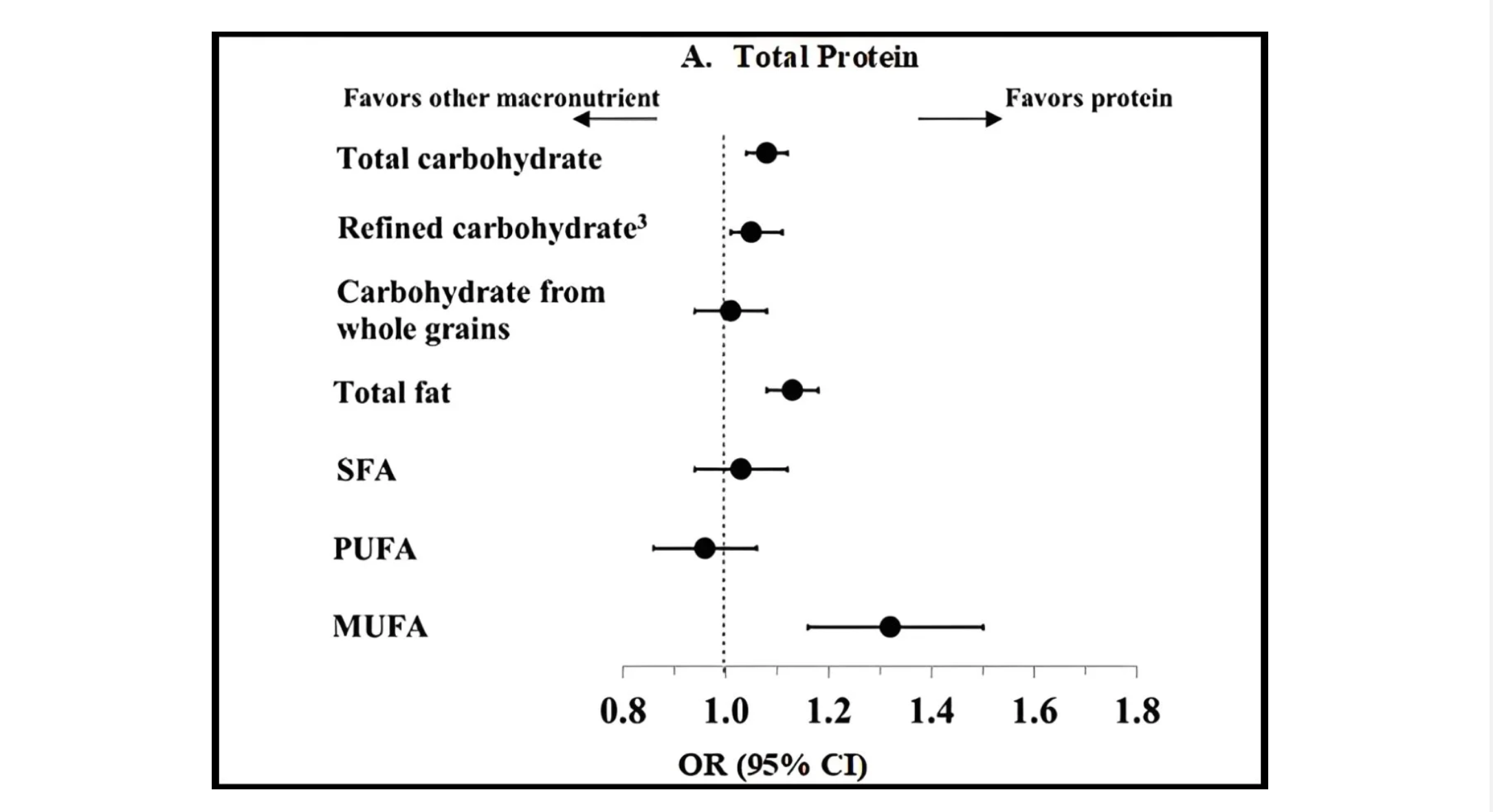
Figure 1
Odds ratios (ORs) (95% confidence intervals) of healthy aging (n ¼ 3721) associated with isocaloric substitution of total protein for dietary carbohydrate (total, refined, and from whole grains) and dietary fatty acids (total, saturated, polyunsaturated, and trans) modeled in 3%-energy increments in 48,762 participants in the Nurses’ Health Study. BMI, body mass index; CI, confidence interval; MET, metabolic equivalent; MUFA, monounsaturated fatty acid; OR, odds ratio; PUFA, polyunsaturated fatty acid; SFA, saturated fatty acid; TFA, trans fatty acid.
Source: Dietary protein intake in midlife in relation to healthy aging - results from the prospective Nurses' Health Study cohort. Am J Clin Nutr. 2024 Feb;119(2):271-282.
The researchers’ insights give us a clear picture of the relationship between protein consumption and longevity. At the study's end, the researchers reported that for every 3% increase in energy intake from total protein, participants significantly improved their odds of healthy aging. Additionally, by replacing calories from other macronutrients (fat and carbohydrates), there was a 22-58% increase in healthy aging.
INTERPRETATION
The findings of this 2024 study shed light on the role of protein in the goal of healthy aging. Beyond merely building muscle mass, protein appears to be pivotal in fostering beneficial longevity, not just physically, but mentally as well. Even if the focus isn’t squatting 500 lbs, but caring more about actively playing with grandkids one day, increasing protein consumption may be a wise move.
My guess as to why protein is important for healthy aging is that while strength and muscle are nice to have when young, they become especially important to offset the consequences that often come with aging, e.g., decrease in muscle mass, decrease in activity.
A high-protein diet will help maintain existing muscle mass that we accumulate in our younger years. In the case of the Korat study, that would be ~22.5% of daily calories coming from protein. Personally, my daily goal is to hit a little bit more than 1g of protein per pound of body weight. Right now I weigh about 190lbs, so I try to get at least 200g of protein per day. What you should know and takeaway from this article is that the loss of muscle tissue as a part of the aging process can be offset by proper exercise and fueling our bodies with the essential amino acids found in high-quality protein sources.
CONCLUSION
The reviewed study is the most compelling data I have seen to suggest a strong correlation between higher protein intake and the likelihood of experiencing healthy aging. Navigating the complexities of nutrition in today’s climate can be difficult, so having a handful of good, evidence-based heuristics is a powerful tool to have at our disposal. Practically, trying to get a high amount of high-quality protein sources at every meal is an easy habit to cultivate now, in order to age well.
RESOURCES
Ardisson Korat AV, Shea MK, Jacques PF, Sebastiani P, Wang M, Eliassen AH, Willett WC, Sun Q. Dietary protein intake in midlife in relation to healthy aging - results from the prospective Nurses' Health Study cohort. Am J Clin Nutr. 2024 Feb;119(2):271-282. doi: 10.1016/j.ajcnut.2023.11.010. Epub 2024 Jan 17. PMID: 38309825; PMCID: PMC10884611.
DISCLAIMER
The information in this article is for educational and informational purposes only and is not intended as medical advice, diagnosis, or treatment. Always consult with a qualified healthcare provider or medical professional before beginning any new exercise, rehabilitation, or health program, especially if you have existing injuries or medical conditions. The assessments and training strategies discussed are general in nature and may not be appropriate for every individual. At Verro, we strive to provide personalized guidance based on each client’s unique needs and circumstances.