The Truth About IV Drips for Sports: Performance Booster or Unnecessary Risk?
Key Points
Limited Evidence of Performance Enhancement: While some studies suggest IV fluids may enhance performance in high-intensity environments, particularly in heat, there is no strong evidence that IV fluids offer a significant advantage over oral hydration, especially in recreational athletes.
Risks and Complications: IV hydration carries potential risks, including infection, electrolyte imbalances, and over-hydration. It should generally be reserved for severe dehydration or specific medical conditions.
Practical Use in Elite Sports: IV fluids might be beneficial for elite athletes in specific conditions (e.g., extreme heat, rapid rehydration needs), but they are not a recommended routine practice for most athletes.
Introduction:
Recently, I had a client walk into the gym absolutely raving about how a recent IV drip made them feel absolutely incredible. They were more energized, and ready to take on the world. I’m always on the lookout to anything that will make my deadlift go up, so I was curious if there was a new secret sauce I should look into. Is there really something to the hype, or is it just another wellness trend? I decided to dive into the research and find out if IV drips are worth the buzz in sports performance.
The use of intravenous (IV) fluids for rehydration in sports has become a topic of interest for athletes and practitioners alike. Initially reserved for medical emergencies, IV fluid administration has expanded into the sports world, primarily for elite athletes seeking performance benefits. However, questions remain about its safety, efficacy, and legality, especially given the restrictions placed by governing bodies like the World Anti-Doping Agency (WADA). This blog will explore the literature surrounding IV fluid use in sports, assess whether it enhances performance, and offer practical advice on its use.
Summary of the Information:
1. Prevalence and Use in Sports: In sports like the NFL, IV fluid use for pre-game rehydration has become more commonplace, with many teams administering saline infusions to their players before games. Some athletes use IVs to maintain hydration in environments where dehydration is a significant concern, such as during endurance events in hot climates (1)(2). IV hydration is also used to prevent or treat exercise-associated muscle cramps (EAMC), which can impair athletic performance (3).
2. Performance Benefits: IV fluids offer a fast method of replenishing lost fluids and electrolytes, which theoretically helps maintain plasma volume and prevent heat-related performance decline. Studies on IV fluid use during and after exercise suggest some benefits, particularly in extreme heat (2). However, the evidence remains mixed. Some research shows no significant difference in performance between IV and oral rehydration (2)(4). Glycerol, when combined with IV fluids, has been shown to improve fluid retention, but its impact on performance is minimal (2).
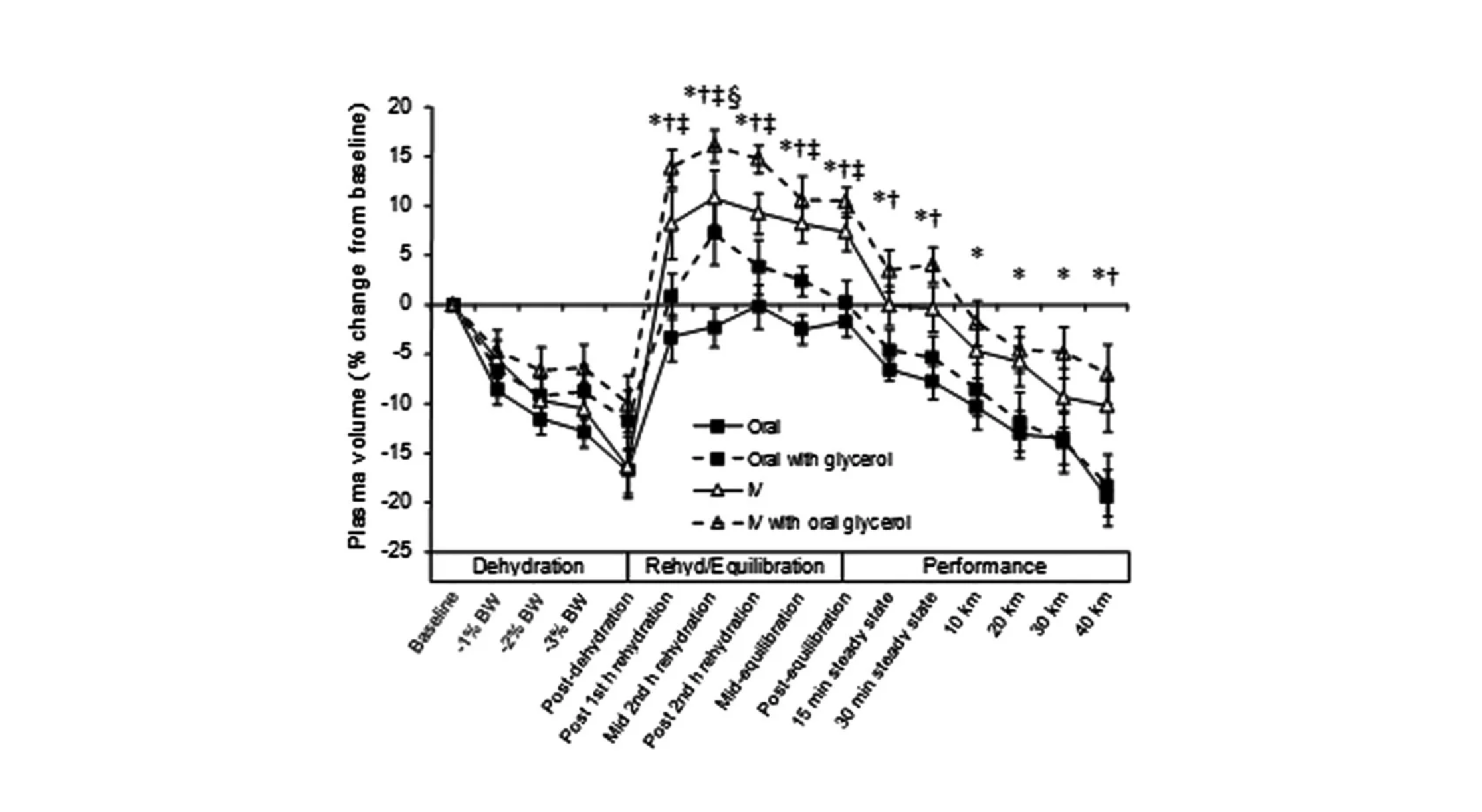
Figure 1
Percent change in plasma volume during exercise-induced dehydration (-4% bodyweight), rehydration with 150% of fluid lost, passive equilibration, and an exercise performance test. See Methods section for detail of the experimental procedures. Data are presented as mean T SEM (n = 9); P G 0.05. Oral versus IV with oral glycerol. ‡Oral glycerol versus IV with oral glycerol. §Oral versus oral glycerol. #IV versus IV with oral glycerol. $Oral glycerol versus IV. BW, body- weight; Rehyd, rehydration.
Van Rosendal (2012)
3. Risks and Complications: Despite the perceived benefits, IV rehydration carries risks, including infections, venous thrombosis, electrolyte imbalances, and over-hydration (3). The rapid introduction of fluids bypasses the body's natural hydration mechanisms, which can cause fluid imbalances and additional complications (4). Moreover, IV fluids do not seem to offer a clear advantage in terms of thermoregulation or endurance in most scenarios (3).
4. Regulatory and Ethical Considerations: IV fluid administration for hydration purposes is heavily regulated under WADA, which prohibits infusions of more than 100 mL over 12 hours outside of hospital settings, except for medical emergencies (3)(4). Athletes seeking to use IV fluids for performance enhancement must be cautious, as violating these rules could result in sanctions. Many professional sports leagues also have their own rules regarding IV fluid use, particularly in weight-class sports like wrestling (3).
Analysis of the Information:
The studies reviewed suggest that while IV hydration may be useful in specific, controlled environments (e.g., extreme heat, medical emergencies), its routine use for athletic performance enhancement is neither necessary nor widely supported by evidence. Oral rehydration remains the gold standard for most athletes, providing sufficient hydration without the risks associated with IV fluid administration. Furthermore, the legal and ethical implications of using IV fluids outside of hospital settings pose significant risks to athletes, especially in competitions governed by WADA.
The appeal of IV fluids lies in their ability to rapidly restore fluid balance, which might seem advantageous in high-stakes environments like professional sports. However, the practical benefits do not justify the associated risks for most athletes, and the potential for misuse underlines the importance of regulation.
Practical Takeaways:
For Most Athletes: Stick to oral rehydration strategies, as they are effective, safer, and align with natural physiological processes. Drinking water and electrolyte-containing beverages before, during, and after exercise is sufficient for maintaining performance and preventing dehydration.
For Elite Athletes in Extreme Conditions: In cases where rapid rehydration is crucial—such as during events in extreme heat—IV fluids may offer some benefit, but should be administered under medical supervision and within regulatory guidelines.
Understand the Rules: If you are a competitive athlete, ensure you are aware of the rules regarding IV fluid use in your sport. Using IV hydration outside of medical emergencies may lead to sanctions.
Glycerol Supplementation: For athletes seeking enhanced fluid retention, consider oral glycerol as part of your hydration strategy. However, note that the performance gains are marginal at best.
Conclusion:
While IV fluids might seem like a convenient and effective way to maintain hydration and enhance performance, the evidence does not support widespread use in sports. The risks associated with IV hydration, combined with regulatory restrictions, make it a less-than-ideal option for most athletes. Oral hydration strategies remain the safest and most effective way to maintain optimal performance and prevent dehydration. Athletes considering IV fluids should carefully weigh the potential benefits against the risks and ensure they stay within the guidelines of their sport's governing bodies.
Sources:
Coombes, J.S., & Van Rosendal, S.P. (2011). Use of Intravenous Rehydration in the National Football League. Clinical Journal of Sport Medicine(Rosendal2011).
Van Rosendal, S.P., et al. (2012). Performance Benefits of Rehydration with Intravenous Fluid and Oral Glycerol. Medicine and Science in Sports and Exercise(VanRosendal2012).
Givon, G.V., & Diehl, J.J. (2012). Intravenous Fluid Use in Athletes. Sports Health(Givon2012).
Pomroy, S., et al. (2019). Intravenous Fluids and their Use in Sport: A Position Statement from the Australian Institute of Sport. Journal of Science and Medicine in Sport(Pomroy2019).
DISCLAIMER
The information in this article is for educational and informational purposes only and is not intended as medical advice, diagnosis, or treatment. Always consult with a qualified healthcare provider or medical professional before beginning any new exercise, rehabilitation, or health program, especially if you have existing injuries or medical conditions. The assessments and training strategies discussed are general in nature and may not be appropriate for every individual. At Verro, we strive to provide personalized guidance based on each client’s unique needs and circumstances.