Weight Releasers: Do Heavier Negatives Actually Make You Stronger?
What 49 studies and a few decades of powerlifting practice say, and a four-week protocol you can actually run
Key Points
Weight releasers let you lower more weight than you can lift, which no ordinary loading method can do.
Across ten long-term trials, overloading the eccentric built about the same maximal strength as normal training.
Faster reps after the plates drop are the exception, and they depend heavily on how you load the bar.
Choose your goal first, because a strength block and a speed block load the bar very differently.
Releaser sets feel harder than the bar weight suggests, so log them as their own exercise.
A set of weight releasers showed up at our gym this summer. The idea is that you are stronger lowering a weight than lifting it, so every normal rep you have ever done was capped by the weaker half of the movement. Releasers take the cap off. You lower a weight you could not possibly press.
A recent 2026 meta-analysis of 49 studies found that over a training block, loading the eccentric this way builds roughly the same maximal strength as ordinary training. What releasers change is narrower. Loaded the right way, the reps that follow a heavy eccentric can move faster, and a handful of controlled trials that overloaded nearly every rep found advantages on at least one strength measure.
That makes releasers a tool with a specific job rather than a shortcut, especially in advanced athletes, and how you load them depends entirely on which job you want done. This post covers what the device does, what the trials found, who is likely to benefit, what experienced coaches do with them, and a four-week protocol you can run, with the loading math worked out and the limits of the hardware accounted for.
What a Weight Releaser Actually Does
Most loading tools change the whole rep. Bands and chains change the resistance through the range of motion, but in both directions. Tempo work slows the lowering without making it heavier than what you can lift back up. A spotter pushing down on the bar gets closer, but the load is whatever your partner feels like applying that day.
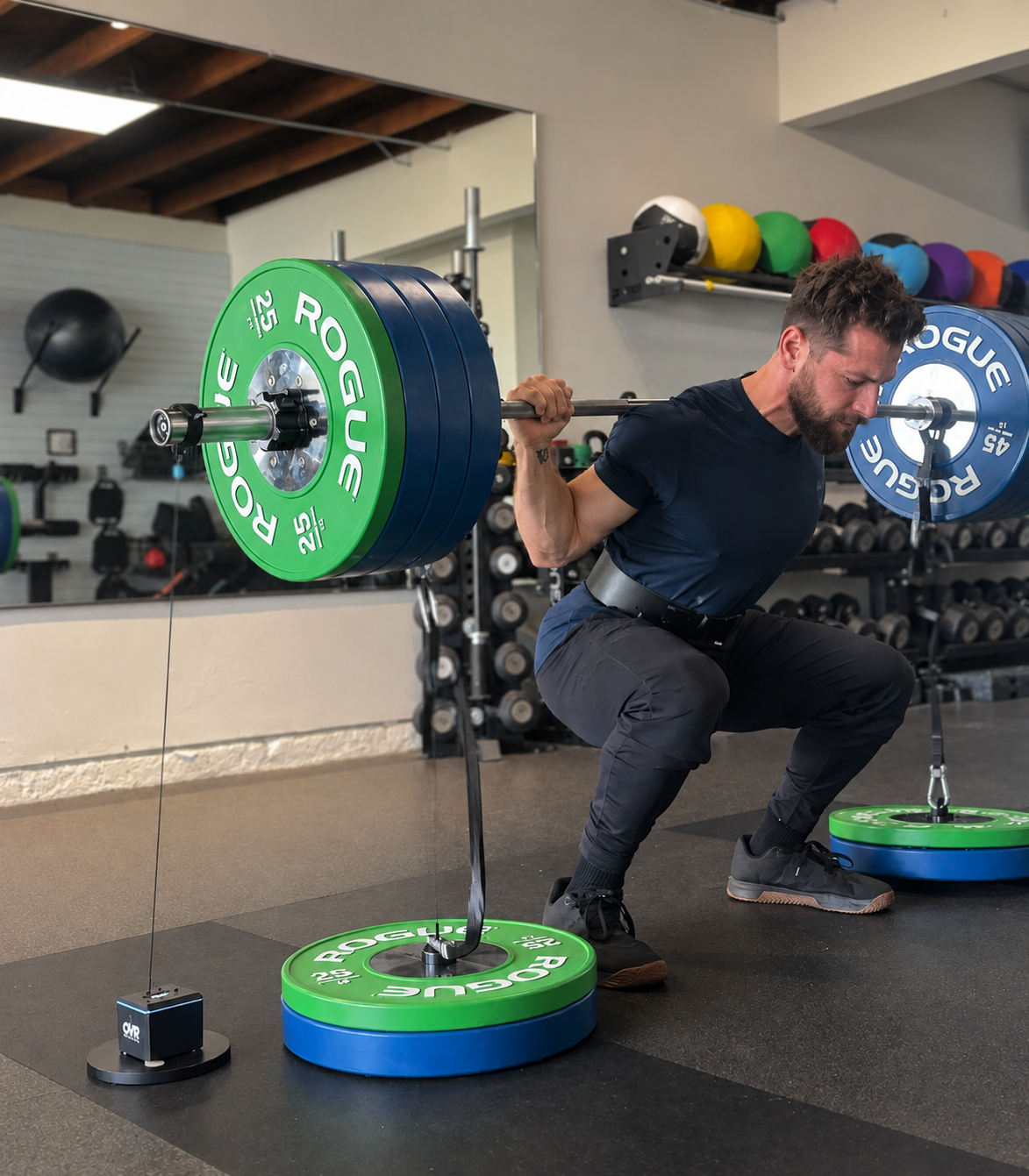
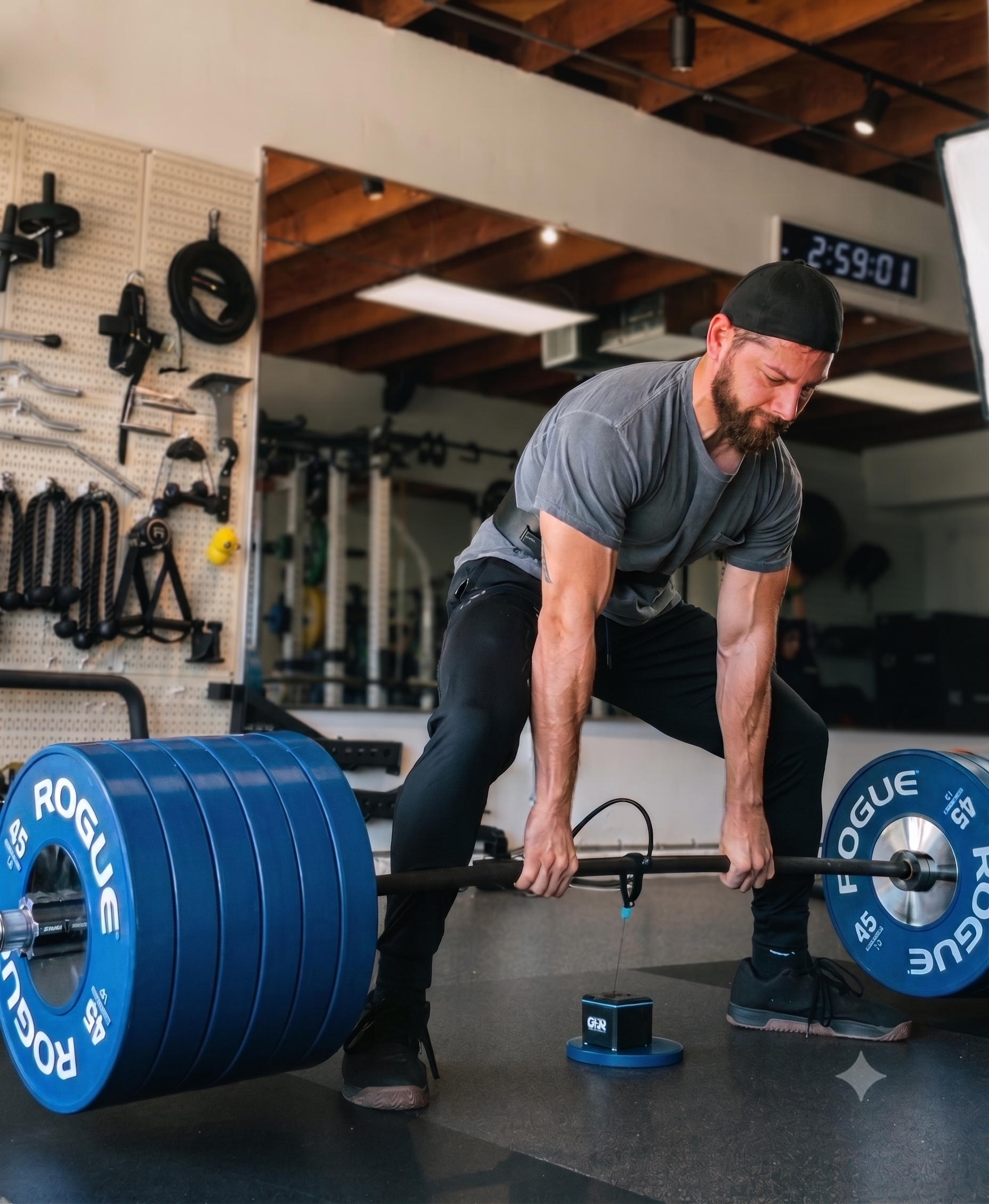
A weight releaser splits one rep into two loads. A traditional releaser hooks over the barbell sleeve and hangs down to a loading post. You load plates onto each one, unrack the bar with everything attached, and lower. Near the bottom, the foot of the releaser touches the floor, the bar travels a little further, and the hook comes free of the sleeve, leaving the extra plates behind. Newer strap-and-pin designs such as FreeMax Fitness Weight Releasers wrap the sleeve with webbing and let the plates go at a height you set.
In the research this is called accentuated eccentric loading, or AEL. Wagle and colleagues (2017) define it precisely: AEL "prescribes eccentric load magnitude in excess of the concentric prescription using movements that require coupled eccentric and concentric actions, with minimal interruption to natural mechanics." That last clause is why releasers are interesting. You are still squatting or benching, and almost nothing about the groove changes.
One mechanical detail shapes everything that follows. Once the plates drop, they stay on the floor. If you want the heavy eccentric on the next rep, someone has to hang the releasers back on, either a partner or two while you hold the bar at lockout, or you, after racking the bar, which is often impractical or impossible. Milo Wolf (2025) calls that cumbersome "in a powerlifting gym, let alone a commercial one," and he is mostly right. It is why most weight-releaser studies of bar speed overload only the first rep of a set, and, as the trials below show, that choice matters.
What the Research Actually Shows
Articles on releasers usually describe the evidence as a handful of small studies that contradict each other. That stopped being true some time ago. Zhang and colleagues (2026) pooled 49 studies and 773 participants comparing AEL with constant-load training, 23 of them using weight releasers. Yang and colleagues (2026) meta-analysed the effect on bar speed within a session. Once you separate what happens over months from what happens within a single workout, the picture is clearer than any individual paper makes it look.
Over a training block: strength and size
Zhang's meta-analysis included 16 long-term training studies. For maximal concentric strength, the number most lifters care about, ten trials produced a pooled standardised effect of 0.12 in favour of AEL (95% CI -0.17 to 0.41, p = 0.41). That is small and not statistically reliable. Limiting it to supramaximal eccentrics, above 100 percent of 1RM, made it smaller still (0.04). Muscle cross-sectional area showed nothing (-0.06, from three trials).
The detail that matters most is the heterogeneity, which was zero. The long-term strength trials do not contradict each other. They agree on a small average effect that may be nothing at all. Zhang's team found only two chronic trials with significantly larger 1RM gains from AEL, one limited to the elbow extensors (Brandenburg & Docherty, 2002) and one in professional weightlifters on a demanding program, and concluded that "we recommend prioritizing constant-load RT for developing long-term strength-related adaptations."
Individual trials show where the edges of that average sit.
| Study | Who | Protocol | Result |
|---|---|---|---|
| Walker et al. (2016) | 28 strength-trained men (10 AEL, 10 traditional, 8 control) | Leg press and knee extension, eccentric = concentric load + 40%, every rep, 10 weeks | Isometric strength +18% with AEL vs +11% traditional; concentric torque +10% vs +9%; knee-extension 1RM +31% vs +36% (no difference); similar muscle growth |
| Douglas et al. (2018) | 14 academy rugby players, squatting about 1.7x body mass | Accentuated eccentric back squats, two 4-week phases | The first, slow-eccentric phase beat traditional training on squat 1RM (effect size 0.48) and sprint speed; the second, fast-eccentric phase impaired speed |
| Yue, Xiong et al. (2025) | 35 participants | Back squat, 4 x 6 at 120% down and 75% up, twice a week for 8 weeks | Overload on every rep beat traditional training on squat 1RM and rectus femoris size; overload on reps 1 and 4 only matched traditional training for 1RM and size but improved jump height and power |
| Yue, Jia et al. (2025) | 22 trained men | Back squat, 3 x 5 on a 70% bar, eccentric at 120% vs 95%, 4 weeks | No meaningful difference between the supramaximal and submaximal eccentric (no traditional-training control) |
| McDowell et al. (2025) | 17 recreationally active adults | Squat and bench with weight releasers and cluster sets, 4 weeks | Squat 1RM rose over time with no advantage for AEL; the authors wrote that the benefit "may not outweigh its logistical burden" |
| Refsnes et al. (2025) | 23 strength-trained athletes | AEL full squats once, twice or three times a week, 12 weeks | Gains were largely similar across frequencies; only concentric maximal strength favoured three sessions over one |
The trials in which AEL beat normal training on a strength measure all put the overload on every rep (Walker et al., 2016; Douglas et al., 2018; Yue, Xiong et al., 2025). Length is less clear-cut than it looks: the advantage in Douglas and colleagues (2018) appeared after a single four-week slow-eccentric phase, while the four-week releaser-cluster block in McDowell and colleagues (2025) did not separate from traditional training. And the one trial that directly compared rep structures found that overloading every rep mattered for strength and size, while a couple of overloaded reps per set was enough for jump height and power (Yue, Xiong et al., 2025). That is one study, but it is the only head-to-head comparison that exists.
Inside a session: bar speed and the loading gap
The acute research asks a different question: does a heavy eccentric make the reps that follow faster or stronger? Here the results really do look contradictory, until you sort them by how light the bar was.
The classic pair is on the bench press. Doan and colleagues (2002) had eight subjects with some experience in weight training lower 105 percent of their 1RM and press 100 percent, and every one of them raised their 1RM, by 5 to 15 lb. Ojasto and Häkkinen (2009) tested eccentrics of 105, 110 and 120 percent and found concentric 1RM and force fell in all three conditions, although Zhang and colleagues (2026) give that result less weight because the constant-load test always came first in the same session.
The velocity studies are where a pattern appears. Yang and colleagues (2026) pooled eight studies of first-rep releaser use in strength-trained lifters. The rep right after the plates dropped was slower, not faster (effect size -0.25), and reps two and three were back to normal (0.01 and 0.08). The slowdown was larger in the squat than in the bench press. Individual studies show how much the bar load matters.
| Study | Lift and subjects | Eccentric / bar load (% 1RM) | What happened |
|---|---|---|---|
| Merrigan, Tufano, Falzone & Jones (2021) | Back squat, 21 resistance-trained men | 120 / 65 and 120 / 80, overload on rep 1 | With a 65% bar, velocity and power rose on the reps after release; with an 80% bar, concentric velocity did not improve |
| Chae et al. (2024) | Back squat, 12 resistance-trained men | 110 / 60, clusters of two with the releasers re-hung each cluster | Higher peak velocity and peak power than traditional sets at the same bar weight, across all ten reps |
| Taber et al. (2021) | Bench press, 10 men benching about 1.5x body mass | 100 or 110 over bar loads of 30 to 80 | A 100% eccentric made reps faster at some bar loads; the authors wrote that 110% "may have been too great to elicit consistent performance enhancements" |
| Merrigan, Tufano & Jones (2021) | Bench press, 8 men and 2 women | 120 / 50 and 120 / 65, overload on rep 1 | Trivial to small effects overall; stronger lifters moved faster at the 50% load |
| Najafi et al. (2026) | Back squat, 14 men squatting about 1.4x body mass | 85 / 65 and 100 / 65, overload on rep 1 | No effect on velocity; the 100% condition was rated RPE 8.5 against 6.9 without releasers |
The squat studies that found faster reps used a wide gap, with the releasers carrying roughly half of 1RM over a 60 to 65 percent bar. A narrower gap on an 80 percent bar did not speed anything up. Yang and colleagues (2026) recommend pairing a supramaximal eccentric with a loading difference of more than 40 percent of 1RM, mainly to limit the slowdown on the reps that follow, but they are candid that the pooled difference between wide and narrow gaps was too small to be practically meaningful. Part of the benefit in cluster designs may also come from the short rests themselves: on the bench, plain rest between reps beat both first-rep and cluster AEL on bar speed and power (Lates et al., 2022).
Who Benefits, and What It Costs
The strength filter, re-examined
The most repeated claim about releasers is that they only work for strong lifters. There is something to it, but it answers a narrower question than people assume.
The acute evidence does point that way. Suchomel and colleagues (2026) split 15 men by whether they could back squat twice their body mass. Under AEL, the stronger group produced greater braking and propulsive force in similar or shorter durations, "suggesting superior utilization of AEL by stronger individuals," although the weaker group actually produced more propulsion impulse under the 110 percent condition, so the split is not clean. Yang and colleagues (2026) noted a similar pattern between two nearly identical studies, one in men squatting about 2.0 times body mass and one in women at about 1.5, which confounds strength with sex, and they could not test relative strength as a formal moderator.
The long-term evidence does not draw that line. The rugby players in Douglas and colleagues (2018), whose slow-eccentric phase produced one of the clearest strength advantages in the literature, squatted about 1.7 times body mass, and we could not find a training study that broke its results down by relative strength. So the fair reading is this: below roughly a double-bodyweight squat, do not expect the reps after the drop to get faster. The small long-term strength effect has not been shown to depend on how strong you are.
Where to set the entry point is still a judgement call, and the most detailed guidance says so. Suchomel and colleagues (2019) suggest no AEL for lifters who squat less than their body weight, submaximal AEL (eccentric below 100 percent of 1RM) around 1.5 times body weight, and maximal to supramaximal AEL at twice body weight or more, while cautioning that some of their recommendations "may be theoretical." From the practitioner side, Mike Tuchscherer (2016) puts it plainly: "this is not a method for beginners."
What it costs you
The intuition is that heavy eccentrics wreck you. The pooled data mostly say otherwise, with one caveat that matters for programming.
Zhang and colleagues (2026) found no meaningful difference from constant-load training in creatine kinase, muscle soreness or jump-measured fatigue. In a four-week block of releaser clusters three times a week, AEL produced less lower-body soreness than traditional training (Lis et al., 2026a), and the authors concluded daily recovery-stress scores showed no major differences (Lis et al., 2026b).
What did change was effort. Ratings of perceived exertion were substantially higher with AEL (pooled effect 1.72), and so was the growth hormone response (Zhang et al., 2026). The authors' advice follows from that: build in longer and more frequent rest periods between sets, avoid very short rests of a minute or less, and consider extra recovery between sessions.
Tuchscherer describes the same profile from the gym floor. "People talk about the extreme soreness from eccentric training. I have not experienced that," he wrote, but the method is "exhausting," "far more taxing than a traditional max attempt," and the cost is more likely to be "your mental and neural fatigue" than soreness (Tuchscherer, 2016). The one trial that clearly went badly used fast eccentrics: the second phase of Douglas and colleagues (2018) impaired sprint speed and "may have exceeded recovery capabilities."
The practical version: controlled releaser work at the doses used in these trials is unlikely to leave you unusually sore, but each set costs more effort than the bar weight suggests. Keep rest periods long, keep the lowering controlled, and do not stack releasers on top of an already high-volume block.
Novelty is a real, small benefit
One more benefit will never show up in a 1RM test. Baz-Valle and colleagues (2019) found no significant difference in strength or muscle-thickness gains between trained men who varied their exercises and men who did not, but only the varied group's motivation to train improved. A systematic review draws the useful line: systematic variation seems to help, while excessive random variation may compromise gains (Kassiano et al., 2022). A releaser block changes the stimulus without changing the lift, which is about as systematic as variation gets. That is a legitimate reason to run one, as long as you are honest that it is the reason.
What Experienced Coaches Do With Them
Releasers are an old powerlifting tool. One of the clearest first-hand accounts comes from Mike Tuchscherer of Reactive Training Systems, who first heard of them "in a Louie Simmons article in that classic PL mag, Powerlifting USA," could not find a set to buy, and had a local welder build one (Tuchscherer, 2016).
Tuchscherer’s progression starts conservatively. Load the releasers to take you "to a 100% eccentric. Then as time goes on you can increase to 105%, 110%... even up to 120%," under one governing rule: "Always remember to ONLY increase the load when you can demonstrate you have control over the current load. Nobody gets stronger from ballistic eccentrics" (Tuchscherer, 2016).
He is candid that he does not know why it works, listing motor learning, reduced inhibition from the Golgi tendon organs and better neural coordination as possibilities before adding, "Or the effect could be psychological." He sizes the effect honestly too: "It's not a giant training effect, but it is something meaningful for a competitive lifter." And he treats it as a short-term tool, "a method that should only be used for a couple of weeks at a time" (Tuchscherer, 2016).
Christian Thibaudeau (2018) loads releasers differently depending on the goal. For overall strength he uses a combined eccentric of 110 to 120 percent of max, with the bar around 80 to 85 percent, doing one slow eccentric rep with the releasers followed by one to three normal reps. For muscle building he drops the bar to about 70 percent with a combined eccentric of 90 to 100 percent, re-hanging the releasers every rep with partners or in clusters, for sets of five. For power he uses a 60 percent bar, as much as another 60 percent on the releasers, and a fast but controlled eccentric.
That spread is typical. In a 2026 survey of 106 strength and conditioning practitioners about AEL for power development, 62 percent reported using it, most often once or twice a week at low volumes of one to three sets of four to six reps, and the most commonly reported limitation was fatigue and recovery demand (Bright et al., 2026).
The strongest counterargument is about muscle growth. Wolf (2025) concludes that "from a hypertrophy perspective, accentuated eccentric loading is a solution in search of a problem," because normal training already provides enough eccentric stimulus. That matches the pooled muscle-size data above. It is not an argument against a small strength or power effect, and some of the studies Wolf cites report exactly that.
A Four-Week Weight Releaser Protocol You Can Run
Nothing below has been tested as a complete program. It is assembled from the loads, rep structures and frequencies used in the trials above, with practitioner judgement filling the gaps where the research is silent, and it says which is which. Pick one option based on your goal.
Before you start
Be trained and technically consistent on the lift. If you squat less than your body weight, skip releasers for now. If you squat around 1.5 times body weight, keep the eccentric at about 95 percent of 1RM in either option, holding the bar weights as written. In one four-week trial, 95 percent over a 70 percent bar performed similarly to a 120 percent eccentric (Suchomel et al., 2019; Yue, Jia et al., 2025).
Be healthy. Tuchscherer's warning is worth taking literally: "That means if you're just coming off an injury, don't use them. If you're prone to injury in a particular muscle, don't use them. If you lack stability or are in ANY WAY unskilled at the lift... DON'T USE THEM" (Tuchscherer, 2016). Zhang and colleagues (2026) also flag AEL as potentially unsuitable for people with heart conditions or uncontrolled high blood pressure.
Use a rack with safeties, and a spotter on the bench. On the bench that means a power rack or spotter arms set just below where the bar touches your chest, plus a spotter. A spotter alone is not a safety. Releasers do not always release: in one review, a FreeMax unit let go on one side but not the other, dumping the bar onto the safeties (Gray, 2026).
Base every percentage on a 1RM you trust. Use a recent tested max or a conservative estimate from normal sets, never a number from a releaser set.
Set-up
Set the release point a few inches above the bottom. Releasers are recommended to disengage about 5 to 10 cm before the lifting phase begins (Yang et al., 2026). On the bench, make sure they let go before the bar reaches your chest.
Test it empty, then light. Check the release with no plates on the releasers first. Then, in Tuchscherer's words, "try it a couple times with a light weight before you increase into your working sets" (Tuchscherer, 2016).
Expect the squat walkout to swing. Tuchscherer's verdict on walking out loaded releasers: "You'd better be very stable before attempting this" (Tuchscherer, 2016).
Lower under control, in about two to three seconds. This is judgement rather than a tested number, but the one trial that used fast eccentrics impaired speed and likely exceeded recovery (Douglas et al., 2018).
Use safety pins. Use of safeties is reccomended, especially if you are not proficient in using weight releasers.
The loading math, and the limit of your hardware
Program the eccentric, not the releasers. Choose the total load you want on the way down as a percentage of 1RM, choose the bar weight, and the releasers carry the difference, split evenly between the two sides. If you change the bar weight partway through the block, recalculate the releasers, because the eccentric percentage moves with the bar.
Then check the hardware. The FreeMax pair we use is marked for 100 lb per releaser. Heavier steel hook releasers exist, so check the rating on whatever you own. At 200 lb for the pair, the wide-gap schemes run out of room quickly on a strong squat.
| Eccentric / bar (% 1RM) | Releasers carry | Largest 1RM a 200 lb pair can serve |
|---|---|---|
| 100 / 75 | 25% of 1RM | About 800 lb |
| 110 / 80 | 30% of 1RM | About 665 lb |
| 100 / 60 | 40% of 1RM | About 500 lb |
| 110 / 65 | 45% of 1RM | About 445 lb |
| 110 / 60 | 50% of 1RM | About 400 lb |
| 120 / 65 | 55% of 1RM | About 365 lb |
That is why the 120 over 65 percent squat scheme that worked in the lab (Merrigan, Tufano, Falzone & Jones, 2021) is out of reach for anyone squatting much over 365 lb on releasers rated 100 lb a side. Use a smaller gap or a heavier bar instead.
Option A: strength block (overload every rep)
Use this if the goal is a bigger squat or bench. It follows the trials in which AEL beat normal training: the overload on every rep, bar loads of 75 to 80 percent and sets of four to six (Douglas et al., 2018; Yue, Xiong et al., 2025), with Tuchscherer's 100 to 110 percent progression layered on top. As written, it is for lifters who squat around twice body weight or more. Nearer 1.5 times body weight, run the same sets and reps with the eccentric capped at about 95 percent. The 110 percent ceiling applies to the bench as well; it is there to build strength, not to speed up the next rep.
On the bench, rack the bar after each rep, re-hang the releasers and go again within about 15 to 20 seconds, or have a partner or two re-hang them while you hold the bar at lockout. On the squat without partners, do not re-rack every rep, since that means sixteen loaded walkouts with swinging releasers. Use clusters of two instead, re-hanging the releasers between clusters, the structure used by Chae and colleagues (2024) and in the four-week block studied by Lis and colleagues (2026).
| Week | Bar (% 1RM) | Eccentric (% 1RM) | Sets x reps | Rest between sets |
|---|---|---|---|---|
| 1 | 75 | 100 | 4 x 3 | 3 to 4 min |
| 2 | 75 | 105 | 4 x 4 | 3 to 4 min |
| 3 | 80 | 110 | 4 x 4 | 4 min |
| 4 | 82.5 | 110 | 3 x 3 | 4 min |
Run one or two AEL sessions per lift each week, as the first main exercise of the day, and leave the rest of the session as it was. One weekly session produced gains similar to two or three for most outcomes in a 12-week trial (Refsnes et al., 2025), and one to two sessions is what practitioners most often use (Bright et al., 2026). If you want back-off work afterwards, keep it to two or three straight sets around 70 percent. No trial has tested that pairing, so treat it as judgement.
A single four-week block has beaten normal training once, in the slow-eccentric phase of Douglas and colleagues (2018), and tied once (McDowell et al., 2025). If strength is the goal, treat four weeks as the first half of an exposure: follow it with a week of normal training and run the block again, restarting at the week 2 loads. That is longer than Tuchscherer's couple of weeks, and it is the one place where the practitioner advice and the trials pull in different directions.
Option B: speed block or first exposure (first rep only)
Use this if you want faster, more forceful reps, or if you have never used releasers and want to learn the set-up before committing to a strength block. Only the first rep of each set gets the overload, so you can run it without a partner. The bar is light, the gap is wide and every lift is driven as fast as you can move it (Merrigan, Tufano, Falzone & Jones, 2021; Yang et al., 2026). The eccentric stops at 110 percent on the squat and 105 percent on the bench: a 100 percent eccentric sped up bench reps at some bar loads while 110 percent did not (Taber et al., 2021), and Yang and colleagues (2026) judged 120 percent likely ineffective on the bench. The 120 over 65 percent squat scheme also exceeds a 200 lb pair of releasers for most squats worth overloading.
| Week | Bar (% 1RM) | Eccentric, squat (% 1RM) | Eccentric, bench (% 1RM) | Sets x reps | Rest between sets |
|---|---|---|---|---|---|
| 1 | 60 | 100 | 100 | 3 x 5 | 3 min |
| 2 | 60 | 105 | 100 | 3 x 5 | 3 min |
| 3 | 65 | 110 | 105 | 4 x 5 | 3 min |
| 4 | 65 | 110 | 105 | 3 x 3 | 3 min |
If you do have a partner, have them hang the releasers back on once mid-set, so reps one and four are overloaded (reps one and three in week 4's triples). That is the structure that improved jump height and power over eight weeks in Yue, Xiong and colleagues (2025). Do not expect a bigger 1RM from this block. Its purpose is force and speed.
What it looks like in plates
Here are both options for a lifter with a 315 lb bench and a 405 lb squat, rounded to the nearest 5 lb, with releaser loads given per side and the weight of the releasers themselves ignored.
| Option and week | Bench bar | Bench lowered | Per releaser | Squat bar | Squat lowered | Per releaser |
|---|---|---|---|---|---|---|
| A, week 1 | 235 | 315 | 40 | 305 | 405 | 50 |
| A, week 2 | 235 | 330 | 47.5 | 305 | 425 | 60 |
| A, week 3 | 250 | 345 | 47.5 | 325 | 445 | 60 |
| A, week 4 | 260 | 345 | 42.5 | 335 | 445 | 55 |
| B, week 1 | 190 | 315 | 62.5 | 245 | 405 | 80 |
| B, week 2 | 190 | 315 | 62.5 | 245 | 425 | 90 |
| B, weeks 3 and 4 | 205 | 330 | 62.5 | 265 | 445 | 90 |
When to back off
If you lose control of the descent, stop the set. Take 5 percent off the eccentric next session and progress only once every rep is controlled, which is Tuchscherer's rule.
A slow first rep after the drop is normal. That is what the pooled data show (Yang et al., 2026). If reps two and three stay noticeably slower than your usual speed at that bar weight, the eccentric is too heavy for you right now. Take 5 percent off.
Expect sets to feel about a point and a half harder than the bar weight suggests (Najafi et al., 2026). If a set at these bar weights turns into a grind, you are past the dose these trials used. End the exercise for the day.
Soreness that lingers well beyond two days is a warning. The pooled data found no more soreness than normal training (Zhang et al., 2026), so if you are much sorer than usual, reduce the load or the number of sets.
Log Releaser Sets as Their Own Lift
A releaser set has two loads, and most training logs have one weight field. That creates a problem that will not show up until you look at your numbers.
Because the eccentric is heavier than the bar, the whole set feels harder than the bar weight suggests. In Najafi and colleagues (2026), squats with a 65 percent bar averaged RPE 8.5 with a 100 percent eccentric, against 6.9 without releasers. Any RPE-based estimate of your max takes that higher RPE at face value, pairs it with the lighter bar and concludes you are weaker than you are. Log a four-week releaser block under your normal squat and your strength trend will show a drop that never happened, and anything that reads that trend, from progression targets to strength percentiles, will act on it.
The fix is simple. Record releaser work as its own variation with the releaser load in the name, such as "Back Squat, +120 lb releasers," and note whether the overload was on every rep or only the first, because those are very different doses at the same load. That keeps the sets in your history and lets you track progress within the protocol without contaminating the main lift. At Verro, the program editor records a releaser set with the added pounds in front of the lift, as "+120REL Back Squat," and tracks it as its own strength series so it never drags down the main lift's trend.
What This Evidence Does Not Support
A reliable long-term strength advantage. The pooled effect on maximal strength is 0.12 and not statistically significant, and the meta-analysis authors recommend prioritising ordinary constant-load training for long-term strength (Zhang et al., 2026). The positive trials are real, but they are the minority.
More muscle. The pooled effect on muscle size is essentially zero (-0.06, from three trials), which is Wolf's (2025) point. One eight-week trial found more rectus femoris growth when every rep was overloaded (Yue, Xiong et al., 2025), which is worth watching but is a single study.
A strength threshold for long-term benefit. The twice-bodyweight squat marker comes from acute studies of bar speed. No training study we found has tested whether stronger lifters gain more from AEL over months.
This protocol as written. The loads and structures come from real trials, but the combination has not been tested, the back-off work is judgement, and a single four-week block has a mixed record against normal training.
Broad generalisation. Most trials had between 10 and 35 participants, most were men in their twenties or early thirties, and many acute studies measured bar speed in a single session rather than strength over a block. Hardware capacity and set-up guidance come from manufacturers, reviewers and coaches rather than from research.
Practical Takeaways
Decide the goal before you load the releasers. For strength, use a 75 to 82.5 percent bar with a 100 to 110 percent eccentric on every rep. For speed, use a 60 to 65 percent bar with the overload on the first rep, up to 110 percent on the squat and 105 percent on the bench.
Program the eccentric, then subtract the bar. Recalculate the releasers whenever the bar weight changes, and check the result against the rated capacity of your releasers.
Stay at or below 120 percent of 1RM on the eccentric. None of the trials in trained lifters reviewed here went higher, and on the bench a 110 percent eccentric did not produce consistent speed gains.
Run strength blocks long enough to matter. Every-rep overload is the common feature of the trials that beat normal training, and a single four-week block has a mixed record, so plan on two blocks.
Keep rest long and the lowering controlled. Rest three minutes or more between sets, and avoid fast supramaximal eccentrics, the one configuration a trial found harmful.
Log releaser sets as their own exercise. Otherwise the higher RPE and lighter bar will manufacture a strength regression in your log.
Skip releasers if you are new, hurt or unstable under the bar. Plenty of people have gotten strong without them.
References
| Citation (APA) | Study Type | Why It Matters | Supports This Claim |
|---|---|---|---|
| Zhang, X., Weakley, J., Li, H., Marcos-Frutos, D., & García-Ramos, A. (2026). Acute and chronic effects of accentuated eccentric loading vs. constant-load resistance training: A systematic review and meta-analysis. Sports Medicine, 56(7), 1749-1770. | Systematic review and meta-analysis (49 studies, 773 participants) | The largest pooled analysis of AEL, covering both acute and long-term outcomes | Long-term strength and size effects are small and not significant; RPE is much higher; longer rests advised |
| Yang, J., Nagatani, T., Comfort, P., Kendall, K.L., & Haff, G.G. (2026). Acute effects of accentuated eccentric loading on mean concentric velocity during resistance training: A systematic review and meta-analysis. Sports Medicine - Open, 12(1), 74. | Systematic review and meta-analysis (8 crossover studies) | Pools first-rep releaser studies in strength-trained lifters, rep by rep | The rep after release is slower, later reps are neutral, and the wide-gap recommendation is only weakly supported by pooled data |
| Wagle, J.P., Taber, C.B., Cunanan, A.J., Bingham, G.E., Carroll, K.M., DeWeese, B.H., Sato, K., & Stone, M.H. (2017). Accentuated eccentric loading for training and performance: A review. Sports Medicine, 47(12), 2473-2495. | Review | The definitional reference for AEL | Definition of accentuated eccentric loading |
| Roig, M., O'Brien, K., Kirk, G., Murray, R., McKinnon, P., Shadgan, B., & Reid, W.D. (2009). The effects of eccentric versus concentric resistance training on muscle strength and mass in healthy adults: A systematic review with meta-analysis. British Journal of Sports Medicine, 43(8), 556-568. | Meta-analysis (20 RCTs) | Compares eccentric with concentric-only training; not AEL-specific | High-intensity eccentric training beats concentric-only training for strength, tied to heavier loads |
| Douglas, J., Pearson, S., Ross, A., & McGuigan, M. (2017). Chronic adaptations to eccentric training: A systematic review. Sports Medicine, 47(5), 917-941. | Systematic review (40 studies) | The general case for eccentric loads beyond concentric strength; not AEL-specific | Eccentric loads not constrained by concentric strength appear superior for strength, power and speed |
| Walker, S., Blazevich, A.J., Haff, G.G., Tufano, J.J., Newton, R.U., & Häkkinen, K. (2016). Greater strength gains after training with accentuated eccentric than traditional isoinertial loads in already strength-trained men. Frontiers in Physiology, 7, 149. | RCT, 10 weeks, n = 28 (including 8 controls) | Long-term AEL in strength-trained men on leg press and knee extension | Isometric strength favoured AEL; concentric strength and muscle growth were similar |
| Douglas, J., Pearson, S., Ross, A., & McGuigan, M. (2018). Effects of accentuated eccentric loading on muscle properties, strength, power, and speed in resistance-trained rugby players. Journal of Strength and Conditioning Research, 32(10), 2750-2761. | Controlled trial, two 4-week phases, n = 14 | One of the clearest barbell AEL advantages, in athletes squatting about 1.7x body mass | Four weeks of slow-eccentric AEL beat traditional training on squat 1RM and sprint speed; fast eccentrics impaired speed |
| Yue, C., Xiong, W., Zhang, C., Zhang, R., Deng, K., & Li, Z. (2025). The effects of accentuated eccentric loading repetition structures on muscle strength and adaptation. Journal of Strength and Conditioning Research, 39(12), 1244-1253. | Controlled trial, 8 weeks, n = 35 | The only long-term head-to-head of every-rep vs partial-set overload | Every-rep overload beat traditional training on 1RM and rectus femoris size; two overloaded reps per set helped jump and power only |
| Yue, C., Jia, C., Zha, W., Zhang, C., Xu, H., & Li, Z. (2025). Submaximal loading as a feasible alternative to supramaximal loading in accentuated eccentric loading during the short-term basic strength block. PLoS ONE, 20(10), e0333613. | Controlled trial (allocated by baseline strength), 4 weeks, n = 22 | Compares a 95% and a 120% eccentric; no traditional-training control | Submaximal and supramaximal eccentrics produced similar short-term results |
| McDowell, K.W., Long, A., Chae, S., Nelson, A., Goode, N., Lis, R., Mizuguchi, S., Baur, M., Duca, M., Wagle, J.P., Fry, A.C., Daniel, G., & Stone, M.H. (2025). Comparison of strength development in traditional set-repetition configuration versus accentuated eccentric loading training over a 4-week strength-endurance block. Journal of Strength and Conditioning Research, 39(8), 850-856. | RCT, 4 weeks, n = 17 | Real weight releasers on squat and bench, confounded with cluster sets | A four-week AEL block gave no 1RM advantage over traditional training |
| Refsnes, P.E., Medbø, J.I., Jakobsen, V., Vilberg, A., & Vikne, H. (2025). One, two, or three times a week? Examining the optimal frequency for strength and muscle growth in accentuated eccentric exercise. European Journal of Applied Physiology, 125(12), 3581-3598. | Controlled trial (three AEL frequencies), 12 weeks, n = 23 | The only trial of AEL frequency; no traditional-training control | One weekly session produced gains similar to two or three for most outcomes |
| Brandenburg, J.P., & Docherty, D. (2002). The effects of accentuated eccentric loading on strength, muscle hypertrophy, and neural adaptations in trained individuals. Journal of Strength and Conditioning Research, 16(1), 25-32. | Controlled trial, 9 weeks, n = 18 | One of two chronic trials with a significant 1RM advantage for AEL | The advantage was limited to the elbow extensors |
| Doan, B.K., Newton, R.U., Marsit, J.L., Triplett-McBride, N.T., Koziris, L.P., Fry, A.C., & Kraemer, W.J. (2002). Effects of increased eccentric loading on bench press 1RM. Journal of Strength and Conditioning Research, 16(1), 9-13. | Experimental (acute), n = 8 | The original detaching-hook bench press study | A 105% eccentric raised bench 1RM by 5 to 15 lb in every subject |
| Ojasto, T., & Häkkinen, K. (2009). Effects of different accentuated eccentric load levels in eccentric-concentric actions on acute neuromuscular, maximal force, and power responses. Journal of Strength and Conditioning Research, 23(3), 996-1004. | Experimental (acute), n = 11 | Tested 105, 110 and 120% eccentrics on the bench; test order is a confound | Concentric 1RM and force fell under all three eccentric loads |
| Merrigan, J.J., Tufano, J.J., Falzone, M., & Jones, M.T. (2021). Effectiveness of accentuated eccentric loading: Contingent on concentric load. International Journal of Sports Physiology and Performance, 16(1), 66-72. | Experimental (acute crossover), n = 21 | Direct test of bar load under the same 120% eccentric in the back squat | A 65% bar gained velocity and power after release; an 80% bar did not gain velocity |
| Merrigan, J.J., Tufano, J.J., & Jones, M.T. (2021). Potentiating effects of accentuated eccentric loading are dependent upon relative strength. Journal of Strength and Conditioning Research, 35(5), 1208-1216. | Experimental (acute), n = 10 | Bench press study modelling relative strength as a factor | Effects were trivial to small overall; stronger lifters moved faster at the 50% load |
| Taber, C.B., Morris, J.R., Wagle, J.P., & Merrigan, J.J. (2021). Accentuated eccentric loading in the bench press: Considerations for eccentric and concentric loading. Sports, 9(5), 54. | Experimental (acute), n = 10 | Bench press AEL across bar loads of 30 to 80% in lifters benching about 1.5x body mass | A 100% eccentric sped up some reps; 110% did not produce consistent gains |
| Chae, S., Long, S.A., Lis, R.P., McDowell, K.W., Wagle, J.P., Carroll, K.M., Mizuguchi, S., & Stone, M.H. (2024). Combined accentuated eccentric loading and rest redistribution in high-volume back squat: Acute kinetics and kinematics. Journal of Strength and Conditioning Research, 38(4), 640-647. | Experimental (acute crossover), n = 12 | Shows a workable cluster structure for re-hanging releasers | 110/60 clusters of two raised peak velocity and power vs traditional sets across all ten reps |
| Lates, A.D., Greer, B.K., Wagle, J.P., & Taber, C.B. (2022). Accentuated eccentric loading and cluster set configurations in the bench press. Journal of Strength and Conditioning Research, 36(6), 1485-1489. | Experimental (acute crossover) | Separates the effect of rest from the effect of the overload | Plain inter-rep rest beat first-rep and cluster AEL on bench velocity and power |
| Najafi, A., Nosaka, K., Javidi, M., Naddafha, S., Kumagawa, D., Bertochi, G.F.A., & Latella, C. (2026). Acute effects of accentuated eccentric loading in comparison to traditional resistance loading on velocity and other parameters in concentric and eccentric phases in barbell back squat. Journal of Strength and Conditioning Research, 40(6), 629-637. | Experimental (acute crossover), n = 14 | Measures RPE alongside velocity in moderately strong lifters | No velocity benefit, and RPE ran about 1.5 points higher at the same bar weight |
| Suchomel, T.J., Cantwell, C.J., Marshall-Ciochon, L.K., Campbell, B.A., Schroeder, Z.S., & Taber, C.B. (2026). Traditional and accentuated eccentric loaded back squat performance: A comparison between stronger and weaker men. Journal of Strength and Conditioning Research, 40(8), 909-919. | Experimental (acute), n = 15 | Splits subjects at a twice-bodyweight squat | Stronger men produced more braking and propulsive force under AEL, with one contrary impulse result |
| Suchomel, T.J., Wagle, J.P., Douglas, J., Taber, C.B., Harden, M., Haff, G.G., & Stone, M.H. (2019). Implementing eccentric resistance training, part 2: Practical recommendations. Journal of Functional Morphology and Kinesiology, 4(3), 55. | Review (applied) | Assigns eccentric methods to training levels, with the caveat that some advice is theoretical | Strength-based entry points for submaximal and supramaximal AEL |
| Lis, R., Long, A., Goode, N., McDowell, K., Nelson, D., Mizuguchi, S., Duca, M., Baur, M., Wagle, J.P., Fry, A.C., & Stone, M.H. (2026a). Chronic comparison of upper- and lower-body muscle soreness in trained individuals completing traditional or accentuated eccentric loading. Journal of Strength and Conditioning Research, 40(7), 739-746. | RCT, 4 weeks, n = 18 | Tracks soreness through a block of releaser clusters | AEL produced less lower-body soreness than traditional training |
| Lis, R., Long, A., Goode, N., McDowell, K., Nelson, D., Mizuguchi, S., Duca, M., Baur, M., Wagle, J.P., Fry, A.C., & Stone, M.H. (2026b). Chronic comparison of Short Recovery Stress Scale in trained individuals completing traditional or accentuated eccentric loading. Journal of Strength and Conditioning Research, 40(8), 920-928. | RCT, 4 weeks, n = 18 | Daily recovery-stress monitoring with releasers re-hung every two reps | The authors concluded AEL created no major recovery-stress differences vs traditional training |
| Bright, T.E., Hughes, J.D., Handford, M.J., Loturco, I., Thapa, R.K., Pontiggia, M., Lim, J., Soriano, M., Taguia, A., & Weldon, A. (2026). An international survey of practitioners' perceptions and practices regarding accentuated eccentric loading for power development in sport. Journal of Strength and Conditioning Research. Advance online publication. | Survey, n = 106 practitioners | Documents how coaches program AEL for power development | Most users program AEL once or twice a week at low volume; fatigue is the top limitation |
| Baz-Valle, E., Schoenfeld, B.J., Torres-Unda, J., Santos-Concejero, J., & Balsalobre-Fernández, C. (2019). The effects of exercise variation in muscle thickness, maximal strength and motivation in resistance trained men. PLoS ONE, 14(12), e0226989. | RCT, 8 weeks, n = 21 | Isolates motivation as the variable exercise variation moves | Varied training matched fixed training for gains but improved motivation |
| Kassiano, W., Nunes, J.P., Costa, B., Ribeiro, A.S., Schoenfeld, B.J., & Cyrino, E.S. (2022). Does varying resistance exercises promote superior muscle hypertrophy and strength gains? A systematic review. Journal of Strength and Conditioning Research, 36(6), 1753-1762. | Systematic review (8 studies, all young men) | Distinguishes useful from harmful variation | Systematic variation seems to help; excessive random variation may compromise gains |
| Tuchscherer, M. (2016, February 1). Using weight-releasers in training. Reactive Training Systems. store.reactivetrainingsystems.com/blogs/advanced-concepts/using-weight-releasers-in-training | Applied (coaching) | A detailed first-hand account of programming releasers in powerlifting | The 100 to 120% progression, the control rule, the sample session, the fatigue profile and the safety warnings |
| Thibaudeau, C. (2018, December 13). My favorite training tool. Thibarmy. thibarmy.com/my-favorite-training-tool/ | Applied (coaching) | Goal-specific releaser loading from an experienced coach | Different bar and releaser loads for strength, muscle building and power |
| Wolf, M. (2025, November 5). Does eccentric overload training enhance muscle growth? Stronger by Science. strongerbyscience.com/eccentric-overload-training/ | Evidence review (applied) | The strongest published counterargument, focused on hypertrophy | AEL adds little for muscle growth, and resetting releasers is impractical |
| Gray, J. (2026, May 1). FreeMax weight releasers review: Great, but also not. GrayMatter Lifting. graymatterlifting.com/freemax-weight-releasers-review/ | Equipment review | Hands-on account of a strap-and-pin releaser, including a failed release | 100 lb per releaser rating, first-rep-only use when training alone, and the need for safeties |
DISCLAIMER
This article is for educational purposes only and is not intended as medical or training advice. Accentuated eccentric loading places loads above your maximum on joints, tendons and connective tissue, and on the bench press it places that load over your chest. It should not be attempted without competent spotting, a rack with safeties set correctly, and equipment rated for the load you are using.
The protocols above are assembled from published trials and practitioner experience rather than tested as complete programs. Most of the research involves young, healthy, trained men, many of the acute findings concern bar speed in a single session, and individual responses to eccentric overload vary considerably. The loading tables are a starting framework, not a prescription.
Consult a qualified healthcare professional before beginning a new training method, particularly if you have a history of tendon, shoulder, knee or lower back injury, or any cardiovascular condition, and a qualified fitness professional before adding supramaximal loading to your program.
At Verro, we view weight releasers as one tool for delivering a specific stimulus to a trained lifter, not as a shortcut, a replacement for consistent training volume, or a determinant of anyone's progress.